How Much Do Calls Cost with Pay-As-You-Go Calling
Table of Contents
Calls cost the published per-minute rate for your destination and number type, paid from prepaid credits starting at $5 that never expire. BubblyPhone bills each started minute as a full minute, with no subscription or connection fee for calling, so check the live rate table before you dial.
The counterintuitive part is that the advertised per-minute figure often isn't the final answer. A short call can consume a full billed minute, a mobile number can cost more than a landline in the same country, and an optional translation feature can add another per-minute charge. The reliable way to answer how much do calls cost is to calculate the exact call you plan to make.
Historically, international calling moved from premium pricing toward domestic-call economics. The average retail price fell from 1.57 per minute in 1983 to 0.42 per minute by the early 2000s, according to World Bank documentation citing TeleGeography. That long decline doesn't mean every destination costs the same today. It means you need destination-level pricing and clear billing rules.
How Much Calls Cost and How the Billing Works
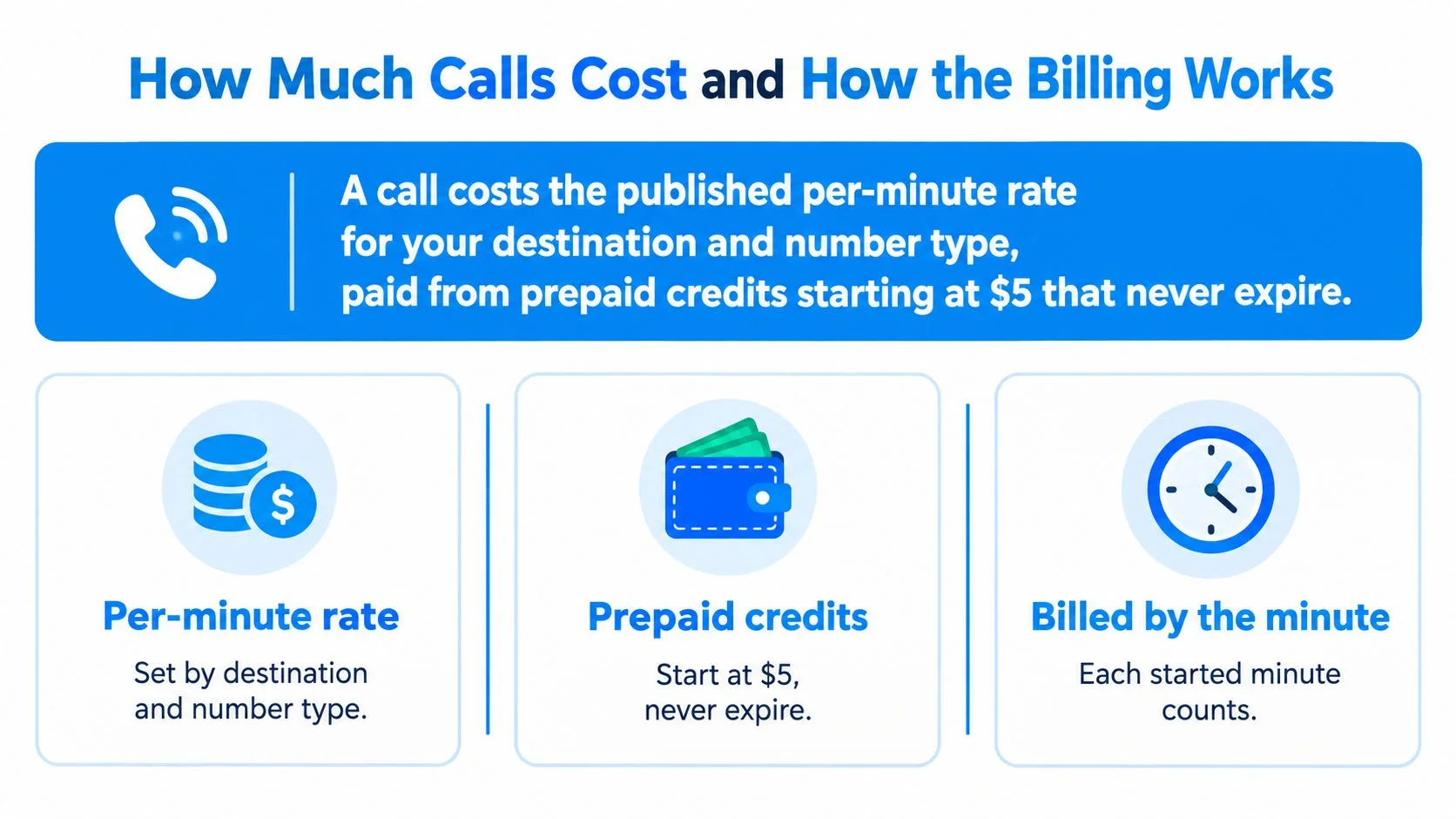
A call costs the published per-minute rate for your destination and number type, paid from prepaid credits that start at $5 and never expire. Calling is billed per minute, rounded up to the whole minute, and doesn't require a subscription.
BubblyPhone publishes rates for 200+ countries and number types before you dial. There are no connection fees or minimum commitments for calling, so the basic calculation is:
Displayed destination rate × rounded-up billable minutes = call cost
That formula gives you a practical maximum for a planned call. First choose the country, then identify whether the number is mobile or landline, estimate the call length, round that duration up to the next whole minute, and multiply by the displayed rate. If you're comparing broader communication costs, you can also find the right subscription tier, but a subscription isn't required for BubblyPhone calling.

The three checks that prevent surprises
- Destination: Rates vary by country and can change as network and regulatory conditions change.
- Number type: A mobile destination may use a different rate from a landline in the same country.
- Billable time: Every started minute counts, even if the conversation ends shortly after that minute begins.
The rate shown immediately before dialing is more useful than an old article quoting a fixed figure. For account-specific questions, the BubblyPhone billing help guide explains how credits and call charges are handled.
Prepaid Credits and the Pay-As-You-Go Model
Prepaid calling means you add credit first, then spend it only on the minutes you use. BubblyPhone credits start at $5, never expire, and can be added by card, PayPal, Apple Pay, or Google Pay.
That structure suits people who call irregularly. A monthly plan can charge during a month when you make no calls, while pay-as-you-go billing keeps the balance available for the next family conversation, supplier call, or travel-related need. Calling itself requires no subscription. The only recurring product is the optional dedicated-number plan, which is separate from outbound calling.
What a first call looks like
A new user can register, add credit, enter a destination number, review the applicable rate, and place a call within minutes. The recipient doesn't need an app or account because the call reaches a regular landline or mobile number.
Suppose you're calling a relative abroad for a planned conversation. You check the country and number type, estimate the duration, and round the estimate up to a whole minute. Your balance then covers the resulting billable minutes at the rate shown before dialing. Money leaves the prepaid balance as the call uses those minutes, rather than through a recurring calling charge.
Practical rule: Add credit based on the calls you actually expect to make, then check the balance before longer conversations.
The model is particularly useful for low-frequency callers, travelers, remote workers, and small businesses that need occasional international access without committing to a recurring calling plan. The guide to topping up your balance covers the available payment methods and the basic process.
A dedicated number is a different purchase. It can support inbound calls, voicemail, and receive-only SMS, and its plan includes monthly calling credit for users who need an ongoing number as well as outbound calling. Don't confuse that optional number plan with the cost of placing ordinary pay-as-you-go calls.
Per-Minute Rounding and What a Short Call Really Costs
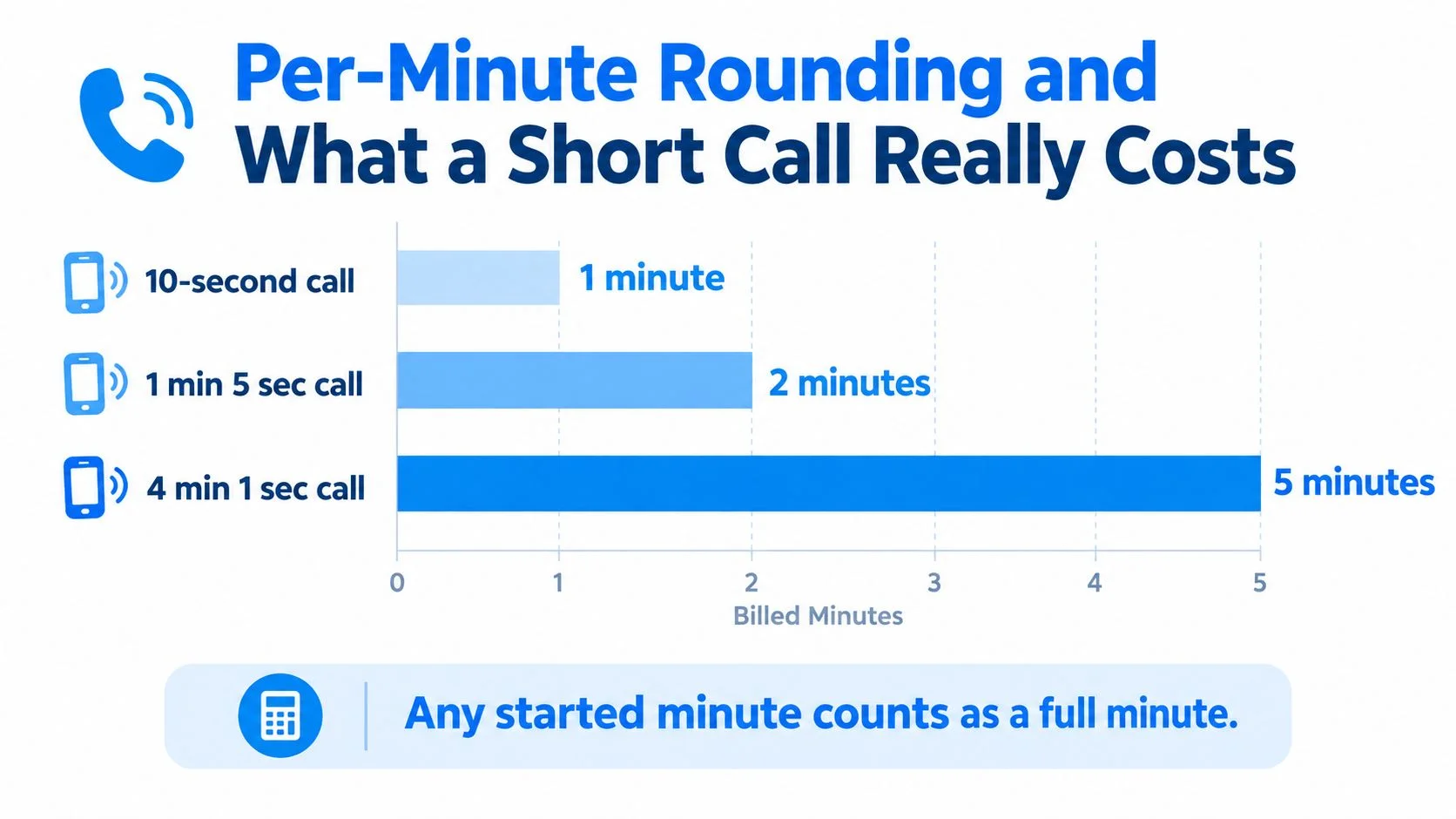
A short call can cost a full billed minute, even when you speak for only a few seconds. Billing rounds the displayed call length up to the next whole minute. A 10-second call bills as one minute, a 1-minute-5-second call bills as two minutes, and a 4-minute-1-second call bills as five minutes.
Apply the formula from the billing section, but focus on the rounding step. At a 0.30 per-minute rate**, a 4-minute-1-second call bills as 5 minutes, so the charge is **1.50 for 4:01 of talk time. That final second adds another $0.30.

There is no connection fee in this calculation. Rounding has the greatest effect on voicemail checks, test calls, brief instructions, and repeated short conversations. For longer calls, the extra billed fraction is usually a smaller share of the total. For frequent short calls, however, compare the rounded billable time with your actual talk time, not just the advertised per-minute rate.
The same rule applies to family calls, delivery checks, and business questions. A team making many brief calls can spend more because of unused portions of billed minutes, even when its destination rate looks low.
Some regulated roaming services use different measurement rules. EU telecommunications rules provide an example where calls can be charged by the second after an initial charging period of no more than 30 seconds, as described in the official EU telecommunications regulation. That rule does not apply universally. Check the service's billing increment before estimating the cost. BubblyPhone's pay-as-you-go calling uses whole-minute billing.
Why Destination and Number Type Change the Price
The country you're calling and whether the number is mobile or landline determine the rate you see. Two calls of the same length can cost different amounts because the destination network, termination route, interconnection arrangement, and local regulation aren't identical.
Think of international calling like a highway with tolls that change by exit, not just by distance. Two destinations at a similar geographic distance may use different interconnection points or require different routing. The ITU's COSITU model illustrates this with single-transit and double-transit termination. In its example, modeled wholesale payment rises from USD 0.1266 per minute to USD 0.2486 per minute, a 96% increase, when the route uses double transit rather than single transit. See the ITU COSITU presentation.
Why mobile numbers often differ
Many countries use a calling-party-pays model for mobile networks. The international caller bears the cost of connecting to the foreign wireless network, and the originating provider may receive an additional connection charge. The U.S. Federal Communications Commission explains foreign mobile surcharges and why mobile termination can affect the retail rate.
That's why you shouldn't assume one universal price per country. Compare the mobile and landline entries separately, especially when you have a choice between a household landline, a business desk phone, and a recipient's mobile.
What to check before choosing a number
- Country code: Confirm that the number belongs to the country you intend to call.
- Network type: Check whether the destination is mobile or landline.
- Route conditions: Understand that transit and termination arrangements can affect the displayed price.
- Current table: Use the live rate rather than relying on a remembered figure.
The practical decision is simple. If the recipient has both mobile and landline access, compare the two live entries before dialing. The cheaper route isn't determined by geography alone.
Optional Add-Ons That Add Per-Minute Charges
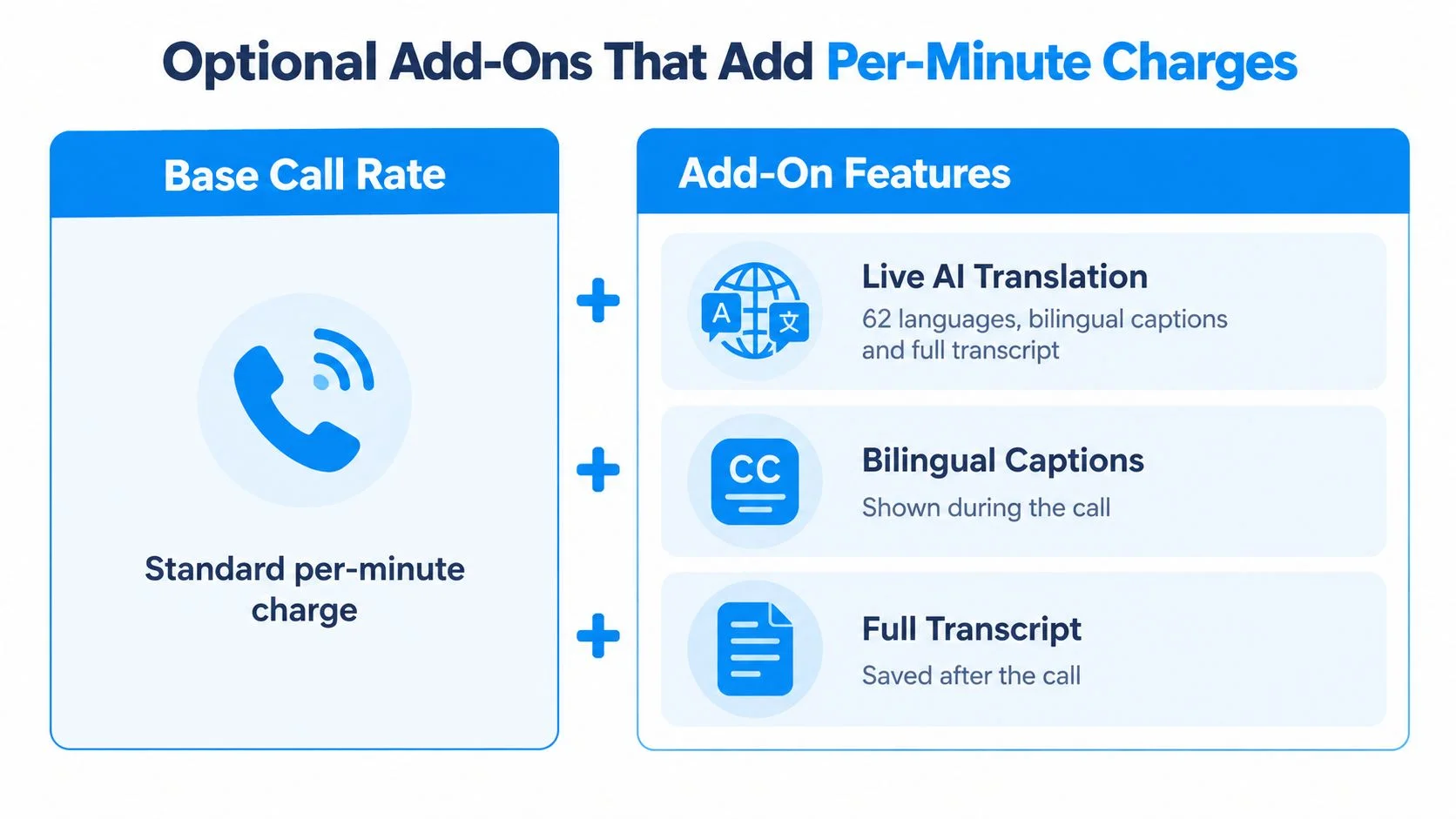
Optional translation and transcription features can add per-minute charges on top of the base call rate. A plain call doesn't include them, so you can keep the calculation to the destination rate multiplied by rounded billable minutes when you don't enable an add-on.
Live AI translation supports 62 languages, with bilingual captions during the call and a full transcript saved to call history afterward. Transcription for incoming calls on dedicated numbers is another optional per-minute feature. These tools can be useful when a language barrier would otherwise slow a business conversation or make a family call difficult to follow.

Compare the two cost decisions
For a family call, enabling translation may add complexity without improving the conversation. For a supplier discussion, bilingual captions and a saved transcript may justify the additional usage cost, particularly when participants need to confirm names, quantities, or follow-up tasks.
Dedicated-number plans include monthly calling credit for people who also want to receive calls, voicemail, and SMS. SMS on dedicated numbers is receive-only. Treat the number plan and optional transcription as separate budget decisions from ordinary outbound pay-as-you-go calling.
How to Check Live Rates Before You Dial
Check the destination and number type, multiply the live rate by your rounded-up expected minutes, and confirm your credit balance. This takes less time than trying to reconstruct a charge after the call.
Use this repeatable pre-call routine:
- Find the destination: Enter the country and confirm the number type.
- Estimate duration: Decide whether the call is likely to last one, two, five, or another number of billable minutes.
- Round up: Treat any started minute as a full minute.
- Check add-ons: Leave translation or transcription disabled unless you need it.
- Confirm credit: Make sure the balance covers the estimated maximum.
- Dial: Review the displayed rate immediately before placing the call.
The BubblyPhone live rate table is the source of truth because rates can change. A cached blog post or an old note may describe a price that no longer applies to the country or number type you're calling.
Free planning tools can make the routine faster. The Call Cost Calculator helps estimate a call from a selected country and duration, Country Code Lookup helps validate the dialing code, and Best Time to Call helps you choose a suitable calling window across time zones.
If you make recurring business calls, record the destination type and your usual rounded duration in your internal process. Review the live rate each time rather than treating a historical estimate as permanent.
Make Your First Call From Any Browser
The practical advantage of browser-based calling is access. BubblyPhone works in a modern browser, reaches landlines and mobiles through enterprise-grade global carrier infrastructure, and doesn't require the person you're calling to install an app or create an account.
The cost model is equally direct:
- Per-minute prepaid billing: You pay for the minutes you use.
- Whole-minute rounding: Each started minute counts.
- Credits from $5: They never expire, and no subscription is needed for calling.
You can place a call from a computer without asking a relative, customer, or supplier to learn a new app. That matters when the recipient uses a basic mobile phone, a landline, or a network with limited data access. Travelers can also separate browser-based calling from their mobile connectivity decisions, just as they might compare options when picking a travel SIM for Japan.
Check the destination-specific rate, identify mobile or landline status, estimate the rounded duration, and decide whether an add-on is necessary. Then use the browser dialer to connect.
Make a call with BubblyPhone from any browser to a regular landline or mobile, without requiring an app or account from the recipient. Check the live rate first, add prepaid credit from $5 that never expires, and pay only for the rounded whole minutes and optional features you choose.