How to Make Calls to Japan: A Complete Guide
Table of Contents
- The correct dialing formula
- Read the prefix before you dial
- Japanese number types at a glance
- Traditional carrier calling
- Prepaid calling cards
- Browser-based dialers
- Calling family in Osaka
- Negotiating with a Tokyo supplier
- Reaching an IP-phone extension
- Plan the time, not just the number
- Keep the conversation considerate
- Check the destination before spending credit
- Reduce the recipient's setup burden
- Use pay-as-you-go credit deliberately
You're probably staring at a Japanese number that starts with 03, 070, 080, 090, or 050, wondering why the call won't connect. To make calls to Japan from abroad, dial +81, remove the number's first 0, and then choose your calling method based on whether you're reaching a landline, mobile, or IP phone.
Dialing Japan From Abroad - The Essential Rule
The essential rule is simple: replace Japan's domestic leading 0 with the international country code +81. A Tokyo number written locally as 03-1234-5678 becomes +81 3-1234-5678 when you call from another country, while a mobile number beginning 070, 080, or 090 becomes +81 70, +81 80, or +81 90.
The correct dialing formula
Use this sequence:
- Start with your international dialing method, usually the plus symbol on a mobile phone or the relevant exit code on a traditional phone system.
- Enter Japan's country code, +81.
- Remove the first 0 from the Japanese domestic number.
- Dial the remaining area code, mobile prefix, and subscriber number.
For example:
The zero isn't part of the international number itself. It acts as a domestic trunk prefix, telling Japan's network that the following digits should be routed as a national call. International routing already supplies the country code, so retaining the zero creates the wrong number structure and can cause the call to fail.
Practical rule: If the Japanese number begins with 0, remove that first zero after adding +81. Don't remove any other zero that appears later in the number.
Japanese callers inside the country use an international access sequence beginning with 010 before the destination country code. From abroad, the normal inverse pattern is exit code, 81, then the rest of the number. Browser dialers and VoIP systems should normalize numbers into a complete international format rather than relying on a local Japanese format, as explained in this guide to the Japan country code.
This format exists within a mature telecom system, not an improvised calling convention. Japan's modern telephone network began in 1890, when the first telephone service connected Tokyo and Yokohama and served about 200 people. Kokusai Denshin Denwa Co., Ltd. was established in 1953 to handle international telecommunications, and International Direct Dialing launched in 1973, making overseas calls more accessible than operator-assisted calling. Japan's telecom sector was liberalized in 1985, accelerating competition and network modernization, as documented in NTT's communications history.
Landline Versus Mobile Numbers - Why the Difference Matters
Japanese landlines, mobile numbers, and IP-phone numbers need the same basic country-code treatment, but they don't follow the same numbering logic or pricing structure. Identify the number type before calling, because a mobile or IP-phone destination can be priced differently from a geographic landline.
Read the prefix before you dial
A Japanese landline normally carries a geographic area code. Tokyo uses 03, so the domestic format 03-1234-5678 becomes +81 3-1234-5678 internationally. The area code identifies a location, which makes the number structurally different from a mobile number.
Japanese mobile numbers are identified by prefixes 070, 080, and 090. A domestic number such as 070-1234-5678 becomes +81 70-1234-5678 from abroad. The same removal rule applies to 080 and 090, but the resulting destination category remains mobile, and that category can affect the price shown by your calling service.
The national numbering plan also includes special prefixes such as 184 for withholding caller ID and 186 for showing caller ID. Those prefixes have a different purpose from geographic and mobile prefixes, so don't treat every leading digit as an area code. The distinctions between Japanese geographic, mobile, and special numbers are summarized in this overview of Japanese telephone numbers.
Japanese number types at a glance
IP-phone numbers beginning 050 deserve separate attention. They may look like ordinary Japanese numbers, but they're not geographic landlines, and the rate applied by a calling service can differ. Public guidance for residents and expatriates also distinguishes landlines, mobile numbers, and IP-phone ranges when discussing telephone costs and setup, as shown in this telephone guide for people living in Japan.
The cost decision is therefore not “What is the rate to Japan?” It is “What type of Japanese number am I calling?” Check the destination category in the live rate table before you place the call, especially when a contact gives you both a landline and a mobile number.
Choosing Your Calling Method - Carriers, Cards, and Browser Dialers
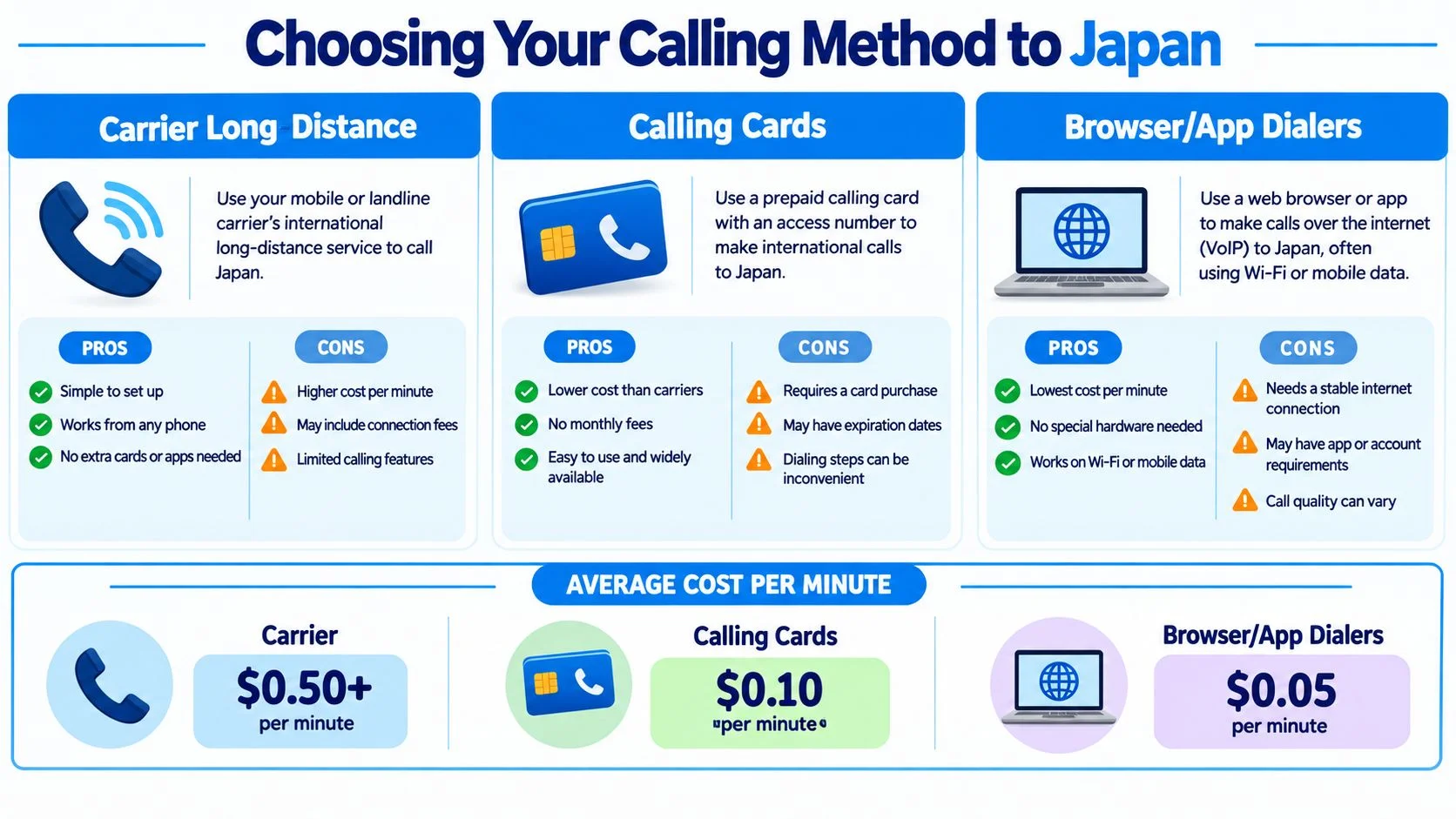
The right calling method depends less on the headline rate than on setup friction, billing clarity, and what the recipient must do. Traditional long-distance calling can be familiar, prepaid cards can work for occasional use, and browser-based dialers remove much of the burden from the person receiving the call.

Traditional carrier calling
A conventional carrier package is straightforward if your phone plan already supports international dialing. You use your normal handset, and the recipient answers normally. The trade-off is that international add-ons, destination categories, connection charges, billing increments, and mobile surcharges can be difficult to assess until you read the full tariff.
This option works well for people who already make frequent overseas calls and understand their plan. It works less well when you need one short call to a Japanese mobile and don't know how your provider classifies the destination.
Prepaid calling cards
Calling cards can separate international charges from your normal phone bill and may be useful when you want a fixed credit balance. They can introduce extra steps, such as access numbers, PINs, expiry rules, or different rates depending on the number type. Before buying credit, check the card's billing increment and whether Japanese landlines, mobiles, and 050 numbers are treated separately.
A guide to international calling cards is useful when you're comparing prepaid access with other ways to place calls.
Browser-based dialers
A browser dialer lets you place the call from a computer or mobile browser while the recipient answers on a regular Japanese landline or mobile. The recipient doesn't need an app, an account, or a compatible calling service, which makes this approach practical for older relatives, suppliers, clients, and support contacts who expect an ordinary phone call.
The compromise is that you still need reliable internet access and should confirm the live destination rate before dialing. For many callers, though, removing recipient setup matters more than adding another app to both sides of the conversation.
Real-World Scenarios - Family Calls, Business Deals, and Support Lines
The number type changes the practical decision in every situation. A family landline, a supplier's mobile, and a company's 050 support number may all be Japanese destinations, but they shouldn't be treated as interchangeable.

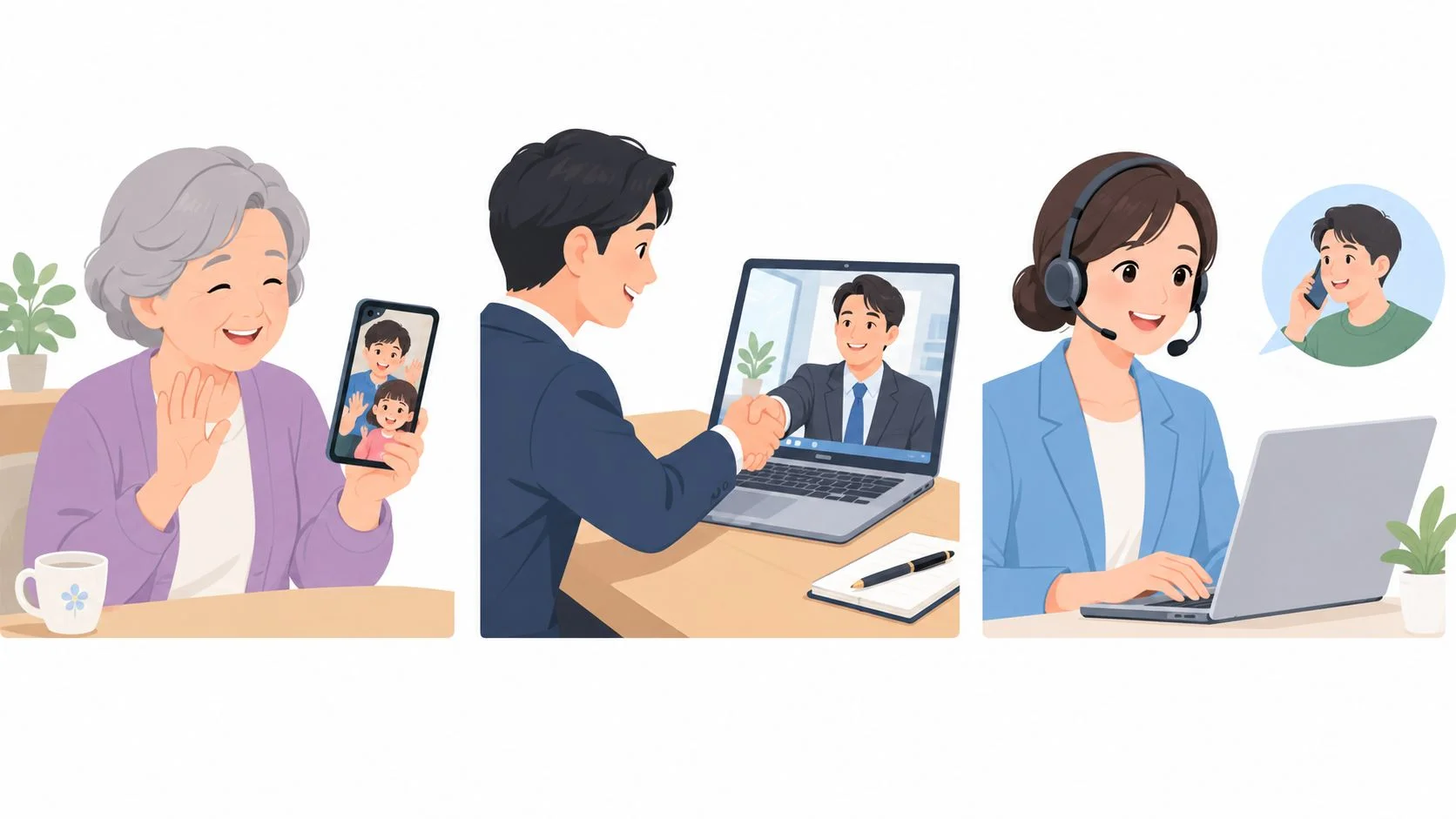
Calling family in Osaka
Suppose your grandparents give you an Osaka landline written in domestic format. First identify the geographic area code, remove its leading domestic zero, and save the result in full international format. A landline is often a sensible choice for a long family conversation because you can avoid accidentally selecting a mobile destination when the household has both types of number.
Save the number with +81 rather than storing only its Japanese domestic version. That prevents a second formatting mistake when you call from a different country or from a browser dialer.
Negotiating with a Tokyo supplier
A supplier may give you a Tokyo office landline and a personal mobile number. Use the office number when the call concerns documents, orders, or a scheduled meeting, and keep the mobile number as a backup for time-sensitive coordination. The mobile prefix tells you that the call may be priced differently, so check the destination category before choosing which number to use.
Business calls also benefit from a short written agenda. Japanese telecom data tracks outbound and inbound international calls as a formal industry metric, and market liberalization expanded carrier participation, creating the mature routing environment used by modern international services. The Telecommunications Carriers Association's telecom data documents this broader market context.
Reaching an IP-phone extension
A customer support contact beginning with 050 is an IP-phone destination, not a Tokyo geographic landline. Enter it internationally as +81 50 followed by the remaining digits, then verify that your service lists IP-phone destinations separately.
Automated systems can also behave differently from personal calls. Keep the account number or extension ready, listen for prompts, and avoid assuming that a call failing at an IVR menu means the country code was wrong. First verify the number type, then test the formatted number and the keypad interaction separately.
Calling Etiquette and Time-Zone Strategy
A technically correct call can still fail socially if it arrives during sleep, commuting, or a meeting. Use 9 AM to 6 PM Japan time as a conservative default for business contacts, then convert that window to your local time before scheduling the call.
Plan the time, not just the number
The easiest method is to check Japan's current local time immediately before dialing and compare it with the clock where you are. For a planned business call, send a short message first and confirm the time in both locations. The best time to call tool can help you avoid doing the conversion from memory.
Japanese business contacts generally appreciate punctuality and preparation. Have the person's name, your purpose, relevant order or account details, and the preferred next step in front of you before the phone rings.
Keep the conversation considerate
Start with a clear greeting and identify yourself quickly. Avoid launching into a long explanation before confirming that the other person can talk, especially if you've reached a mobile number.
Silence may be part of a careful response rather than a signal that the call has failed. Don't interrupt to fill every pause. If the matter requires documents, screen sharing, or visual context, ask whether a video meeting would be more appropriate instead of forcing a voice call to handle work that needs visual material.
Making Your Next Call to Japan Easier
A call to Japan can become expensive or fail to connect for a simple reason: the number type was never checked. Before dialing, format the number internationally, identify whether it reaches a landline, mobile, or IP phone, then choose a method that does not create extra work for the person answering.
Check the destination before spending credit
Save the number in international format and inspect its prefix:
- Geographic code: A number such as 03 identifies a landline area. Remove the domestic zero when converting it for international dialing.
- Mobile prefix: Numbers beginning 070, 080, or 090 reach Japanese mobiles and may fall into a different rate category.
- IP-phone prefix: A number beginning 050 is not a geographic landline, so check its pricing separately.
- Special service prefix: Caller-ID controls and other special functions may not work like ordinary subscriber numbers.
The number type affects both price and connection success. A generic “Japan” rate may hide separate charges for landlines, mobiles, and other destinations. Check the live Japan calling rates immediately before dialing because pricing can change.
Reduce the recipient's setup burden
Browser-based calling works well when the person in Japan should receive a regular phone call rather than install an app or create an account. They can answer on a standard landline or mobile while you place the call from a modern browser.
That arrangement suits family members who prefer familiar phones, suppliers who will not set up an account for one conversation, and clients who need a normal phone ring. You can still use a mobile app while traveling, without asking the recipient to change their usual communication habits.
Use pay-as-you-go credit deliberately
For occasional calls, pay-as-you-go billing avoids a subscription. Calls are billed by the minute and rounded up to the next whole minute, so crossing into another billing minute charges that full minute. Set a spending limit, confirm the destination category first, and end the call when the work is complete.
BubblyPhone works in any browser and connects to Japanese landlines, mobiles, and IP-phone numbers. The recipient needs no app or account, while credits start at $5 and never expire. BubblyPhone fits calls where you want direct dialing without a monthly calling subscription or recipient setup.
For a family landline, Japanese mobile, or IP-phone number, check the prefix before choosing the call method. That small step helps you select the correct rate category and avoid asking the person in Japan to install anything. Credits start at $5 and never expire, so visit BubblyPhone and place the call when you're ready.