606 Area Code: Eastern Kentucky Location, Time Zone & Scam Check (2026)
The 606 area code covers eastern Kentucky's Appalachian region — from Ashland to Pikeville to Middlesboro. Learn about coverage area, time zone, scam protection, and the coal country where the Hatfield-McCoy feud reached the Supreme Court.
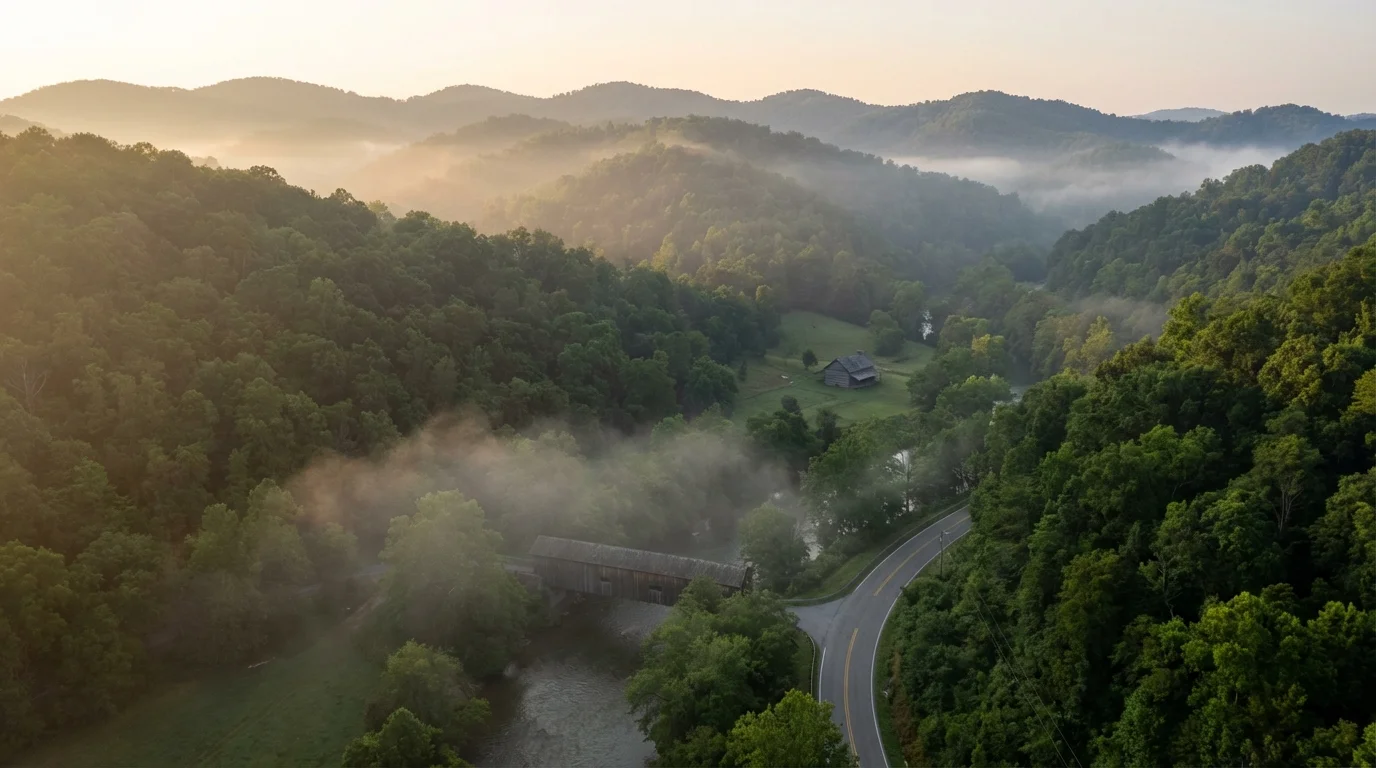
The 606 area code covers eastern Kentucky — roughly 50 counties of Appalachian mountain country running along the state's borders with Virginia and West Virginia. Created in 1955 as a split from the original 502, it serves approximately 1.2 million people across coal country, from Ashland to Middlesboro to Pikeville.
This is one of the last area codes in America where you can still dial seven digits. It's also the region where the Hatfield-McCoy feud went to the Supreme Court, where LBJ launched the War on Poverty from a man's front porch, where horseback midwives cut the maternal death rate by 75%, and where the only city on Earth built inside a meteor crater still mines coal from the impact zone.
606 Area Code Quick Facts
Cities in the 606 Area Code
| City | Population | County |
|---|---|---|
| Ashland | 20,000 | Boyd |
| Somerset | 12,000 | Pulaski |
| Pikeville | 7,000 | Pike |
| London | 8,000 | Laurel |
| Corbin | 7,300 | Whitley/Knox |
| Middlesboro | 9,200 | Bell |
| Hazard | 5,400 | Perry |
| Morehead | 7,500 | Rowan |
| Paintsville | 4,000 | Johnson |
| Maysville | 8,800 | Mason |
| Prestonsburg | 3,500 | Floyd |
| Harlan | 1,500 | Harlan |
606 Area Code Timeline
One of the original 86 area codes. Covered the entire state of Kentucky.
January 1 — Eastern half of Kentucky splits from 502 to form 606. Covers everything from Lexington to the Virginia and West Virginia borders.
Lexington and Northern Kentucky split from 606 to form 859. Rural eastern Kentucky retains the 606 code to spare residents the cost of changing numbers.
The Hatfield-McCoy Feud: Blood War to Supreme Court
America's most famous family feud played out across the Tug Fork River between the Hatfields of West Virginia and the McCoys of Pike County, Kentucky — deep in 606 territory. The conflict ran from roughly 1863 to 1891.
The violence escalated relentlessly. In August 1882, Ellison Hatfield was stabbed 26 times and shot while lying on the ground. In retaliation, three McCoy brothers were tied to pawpaw bushes and executed with approximately 50 shots. On New Year's Day 1888, the Hatfields surrounded Randall McCoy's cabin, set it on fire, killed his son Calvin and daughter Alifair, and beat his wife Sarah so badly she suffered a crushed skull.
The feud reached the U.S. Supreme Court in 1888 when West Virginia challenged Kentucky's seizure of a Hatfield associate without extradition papers. The Court ruled 7–2 in Kentucky's favor. Seven Hatfield associates received life sentences; the eighth, Ellison "Cottontop" Mounts, was hanged on February 18, 1890, before thousands of spectators.
"Bloody Harlan": The Coal Mine Wars
The Harlan County War (1931–1939) erupted after the coal operators' association cut miners' wages by 10% on February 16, 1931. Only three of Harlan's incorporated towns were not company-owned. Miners who joined unions were fired and evicted from company homes.
The Battle of Evarts (May 5, 1931) was a 30-minute firefight that killed three deputies and one miner. By the war's end, at least 13 miners and 5 mine guards had been killed. Decades later, director Barbara Kopple documented the 1973 Brookside Mine strike in Harlan County, USA — 180 miners striking against Duke Power for 13 months.
Striker Lawrence Jones was fatally shot during a scuffle; his death finally brought both sides to the bargaining table. The film won the Academy Award for Best Documentary (1976). At its peak, Kentucky coal employed over 29,000 workers. By 2020, eastern Kentucky had lost 82% of its coal jobs.
The Porch That Launched the War on Poverty
On April 24, 1964, President Lyndon B. Johnson traveled to Martin County, Kentucky, and sat on the front porch of Tom Fletcher's home near Inez. Fletcher was an unemployed sawmill operator who had earned only $400 the previous year. He had a wife and eight children.
Photographers captured what became one of the most iconic images of the War on Poverty — the President crouched on the porch, chatting with Fletcher about the lack of jobs. The visit helped crystallize public support for the Economic Opportunity Act of 1964.
Fletcher was never able to escape poverty and remained poor for the rest of his life. On the 50th anniversary in 2014, Martin County's poverty rate was 35 percent — more than double the national average. Government aid remains the largest source of income in the county.
30 Times Worse Than the Exxon Valdez
Just after midnight on October 11, 2000, the bottom of a coal slurry impoundment owned by Massey Energy in Martin County broke through into an abandoned mine below. An estimated 306 million gallons of toxic coal slurry poured into tributaries of the Tug Fork River — approximately 30 times larger than the Exxon Valdez oil spill.
The slurry contained arsenic and mercury. It killed everything in the waterways, polluted 200–300 miles of river, and covered residents' yards in sludge over 5 feet deep. The fine: Martin County Coal paid $3.25 million — the largest mining-related fine in state history at the time. MSHA assessed $110,000 in civil penalties. Massey Energy reported spending $58.8 million in cleanup, of which $52.5 million was covered by insurance. The EPA called it one of the worst environmental disasters in the southeastern United States.
Horseback Midwives Who Saved Thousands of Lives
In 1923, Mary Breckinridge rode horseback over 650 miles through the hills of Kentucky to survey midwives. She found the average midwife was 60 years old and the level of care was medieval. In 1925, she founded the Frontier Nursing Service in Hyden, serving approximately 700 square miles of Leslie County.
British-trained nurse-midwives traveled on horseback to provide prenatal and childbirth care in clients' homes. The results over 50 years: 17,053 babies delivered with only 11 maternal deaths — a maternal mortality rate of 9.1 per 10,000 births versus the national rate of 34 per 10,000. Low birth weight rate: 3.8% versus 7.6% nationally. The service registered over 64,000 patients.
The Only City on Earth Built Inside a Meteor Crater
Middlesboro sits inside an astrobleme — a meteor impact crater approximately 3 miles wide, created by a meteorite estimated at 100 meters in diameter hitting less than 300 million years ago. The surrounding mountains rise 1,000 to 1,900 feet above the crater floor.
The crater was identified in 1966 when geologist Robert Dietz discovered shatter cones in sandstone — a pattern formed only during impact events. The city was founded in 1886 by Alexander A. Arthur to exploit iron and coal deposits; he had no idea he was building inside an extraterrestrial impact structure. Middlesboro is the only place in the world where coal is mined inside a meteorite impact crater.
Butcher Hollow: Coal Miner's Daughter
Loretta Lynn grew up in Butcher Hollow (pronounced "Butcher Holler"), a tiny community two miles southeast of the coal camp of Van Lear in Johnson County. The second of eight children, she lived in a cabin with wallpaper made from Sears Roebuck catalog pages. Nightly dinners were bread dipped in gravy.
In her autobiography, she called Paintsville "the first place I ever saw a toilet with running water." Marriage records showed she married just before her 16th birthday — she became a mother at 17, had four children by 19, and was a grandmother at 29. Her siblings Crystal Gayle and Peggy Sue Webb also became recording artists. The family home is now a tourist attraction at $5 per tour, starting at Webb's Grocery — the former Van Lear Consolidated Company Store.
Daniel Boone's Wilderness Road
In March 1775, Daniel Boone and around 30 axmen departed to cut a road through the Cumberland Gap — the narrow passage through the Appalachian Mountains in what is now Bell County (606 territory). The land deal behind it: 20 million acres purchased from the Cherokee for 10,000 pounds of goods.
Over the next 35 years, approximately 300,000 settlers used the Wilderness Road as the primary pathway to the western frontier. Today, the Cumberland Gap Tunnel (opened October 18, 1996) consists of twin bores each 4,600 feet long. Construction cost $280 million — double the original estimate after engineers hit unexpected underground streams. The old two-lane route had an accident rate 6 times higher than comparable highways.
606 Area Code Tools
Related Area Codes
Need an Eastern Kentucky Number?
Get a Kentucky area code number with BubblyPhone. Make affordable international calls, keep your existing number, and stay connected to the 606.