How Do You Dial Ireland from Anywhere in 2026
Table of Contents
- What each part actually means
- The format to remember
- Republic of Ireland Dialing Examples by Line Type
- Toll-free and service-number examples
- International Dialing Sequences by Caller Country
- Worked examples that match real situations
- The easiest option on a smartphone
- Republic of Ireland vs Northern Ireland Dialing
- The difference that matters
- How to avoid the wrong-country mistake
- The most common failures and the fix
- Fast self-check in under a minute
- Two copy-and-use examples
- The practical way to place the call
You're probably staring at an Irish number right now and wondering why your call won't go through. The short answer is simple: for the Republic of Ireland, dial your exit code, then 353, then the Irish number without the leading 0. If you're calling Northern Ireland, use +44, not +353.
The Core Ireland Dialing Format at a Glance
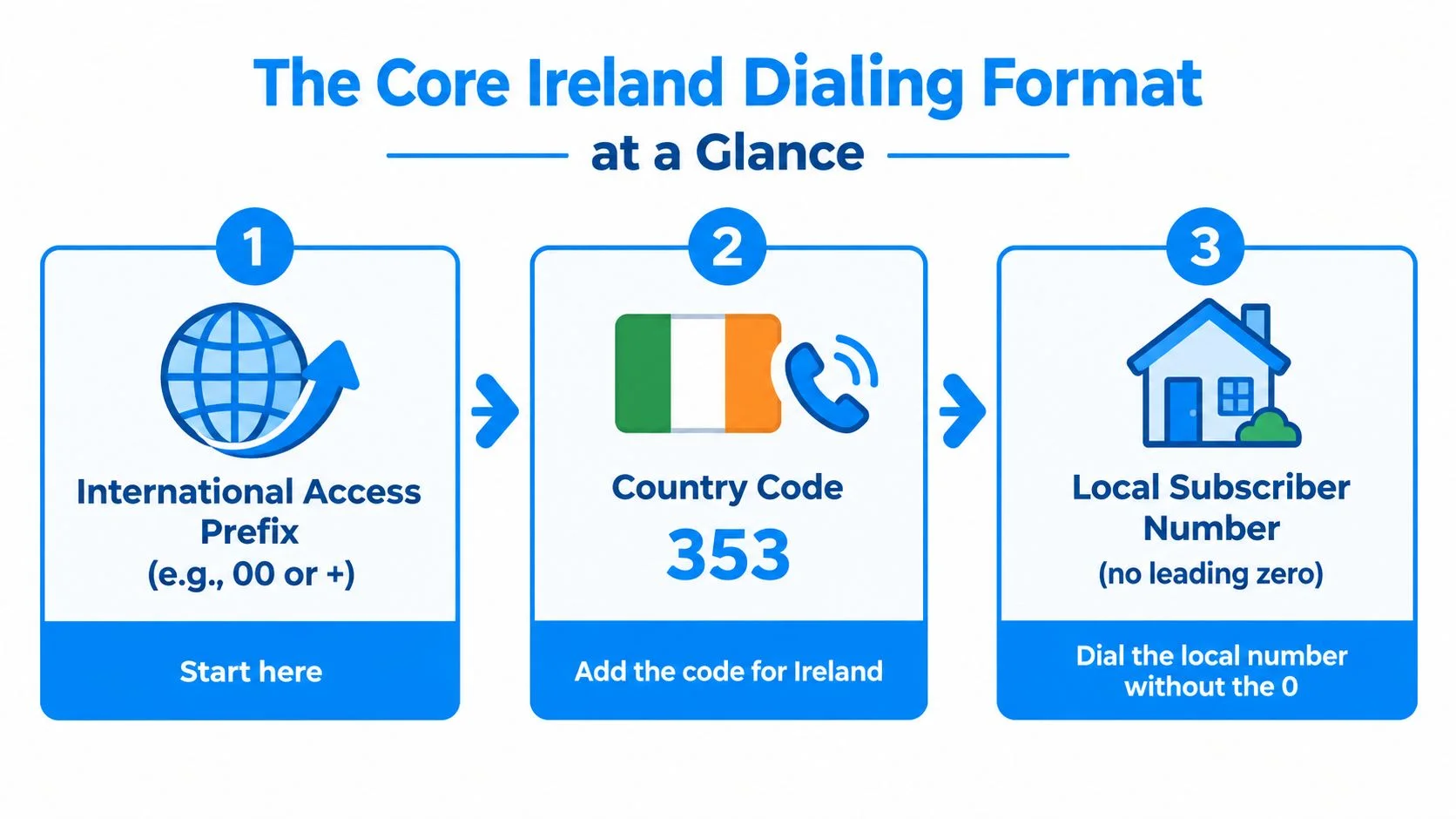
If you're asking how do you dial Ireland, the base format is international access prefix + 353 + Irish number without the domestic 0. That's the one pattern that works consistently for calls into the Republic of Ireland, and it matches Ireland's international numbering format described in Ireland's national numbering plan.

What each part actually means
The first part is the international access prefix. That tells your network the call is leaving your country. In many places that prefix is 00, while callers in the US and Canada usually use 011 before the country code, as summarized in this Ireland international dialing guide.
The second part is 353, which is Ireland's country code under the E.164 numbering system, as reflected in Ireland's dialing code listing.
The last part is the local Irish number, but with one change. You remove the leading 0 that appears in domestic Irish dialing. Ireland uses an open numbering plan, and domestic geographic numbers often start with a trunk prefix such as 01 for Dublin. International callers skip that trunk 0 and dial the rest after +353, as shown in ComReg's numbering guidance.
Practical rule: If the Irish number is written for local use and starts with 0, drop that 0 before you add +353.
The format to remember
Use this pattern:
- From a landline abroad: exit code + 353 + Irish number without the 0
- From a smartphone: +353 + Irish number without the 0
- For a saved contact: save it in full international format so it works from different countries
A mobile phone usually makes this easier because the plus sign stands in for your local exit code. If you want a quick reference for that format, BubblyPhone's Ireland country code guide lays it out cleanly.
Mobile, Landline, and Toll-Free Examples
A lot of failed Ireland calls happen after the country code is already correct. The mistake is usually in the number type. A mobile, a Dublin landline, and a freephone number do not behave the same way once you convert them for international dialing.
Republic of Ireland Dialing Examples by Line Type
Here is the practical difference.
A mobile keeps the mobile prefix once the domestic 0 is removed. If the number is written locally as 087 234 5678, the international version is +353 87 234 5678. This is the format I save in contacts because it works from a phone dialer, WhatsApp, and most business VoIP apps.
A Dublin landline follows the same conversion, but the remaining area code is shorter after you drop the 0. 01 234 5678 becomes +353 1 234 5678.
A regional landline works the same way. 021 234 5678 in Cork becomes +353 21 234 5678. If you are checking a number by eye, people often hesitate because the spacing changes. That is normal. What matters is dropping the domestic 0 and keeping the rest of the digits in order.
Keep one mistake in mind. If you dial +353 01... or +353 021..., many carriers will reject the call because that trunk 0 should not be there in international format.
Toll-free and service-number examples
1800 numbers cause more confusion than mobiles or landlines. The correct international format is +353 1800 123 456, not +353 1 800 123 456.
That formatting matters, but so does the billing side. An Irish freephone number may be free for someone calling inside the Republic of Ireland and still fail from abroad, or connect and charge like a normal international call. The number format can be right and the call can still be blocked by the business, the carrier, or the service setup.
Use these checks before assuming the number is wrong:
- 1800 numbers: dial as +353 1800 plus the remaining digits
- 1890 numbers: treat them as service numbers, not freephone numbers
- 0800 numbers: expect those more often on UK numbers, including Northern Ireland, rather than numbers in the Republic
If a company gives both a standard geographic number and an 1800 number, the standard number is usually the safer choice from outside Ireland. That is one of the simplest workarounds when a freephone call will not connect.
Dialing Ireland From Common Countries
The Irish number itself usually stays the same. What changes is the exit code you use before 353. That's why the same Dublin number can look different depending on whether you're calling from the US, the UK, mainland Europe, or Australia.
International Dialing Sequences by Caller Country
Worked examples that match real situations
From the United States or Canada, a Dublin landline becomes 011 353 1 234 5678. An Irish mobile becomes 011 353 87 234 5678.
From the United Kingdom, including callers in Northern Ireland placing a call to the Republic, the international string starts with 00. So the same Dublin number becomes 00 353 1 234 5678.
From mainland Europe, the pattern is usually the same as the UK for international access. Dial 00 353 and then the Irish number without the local 0.
From Australia, the exit code changes again. A Dublin landline would be 0011 353 1 234 5678.
The easiest option on a smartphone
On a smartphone, the easiest move is to skip memorizing exit codes and enter the number with a plus sign. Hold the 0 key to produce +, then enter 353 and the rest of the number without the leading 0.
That's especially useful if you're traveling and changing countries, because your phone handles the local international prefix for you.
Save Irish contacts in full international format. It avoids redialing mistakes later from airports, hotels, and borrowed office lines.
If you're planning a trip and expect to call hotels, guides, or restaurants while moving around the island, a good itinerary source can help you confirm whether a contact is in the Republic or in the UK numbering zone. This Ireland luxury travel advisor is useful for that practical planning angle.
Republic of Ireland Versus Northern Ireland
Many failed calls start. The Republic of Ireland and Northern Ireland are on the same island, but they do not use the same country code.
Republic of Ireland vs Northern Ireland Dialing
The difference that matters
The Republic of Ireland uses +353. Northern Ireland uses the UK's +44 numbering system. Neutral travel guidance regularly points out that many travelers mix up the two, especially because general “Ireland” dialing guides often only explain the Republic format, as noted in this telephones guide for Ireland travel.
So a Dublin number might look like +353 1 234 5678, while a Belfast number looks like +44 28 9012 3456. Those are not interchangeable.
How to avoid the wrong-country mistake
Use this quick check before you dial:
- If the number belongs to Dublin, Cork, Galway, or another city in the Republic: use +353
- If the number belongs to Belfast or another location in Northern Ireland: use +44
- If the mobile is written in a UK-style pattern: treat it as UK numbering, not Republic of Ireland numbering
One reason this confusion persists is history. Ireland changed its international access code from 16 to 00 in 1992, and cross-border dialing also shifted in 2000 when old Republic-to-Northern-Ireland formats were replaced after UK renumbering, as described in this historical overview of Irish telephone numbering.
Troubleshooting Calls That Will Not Connect
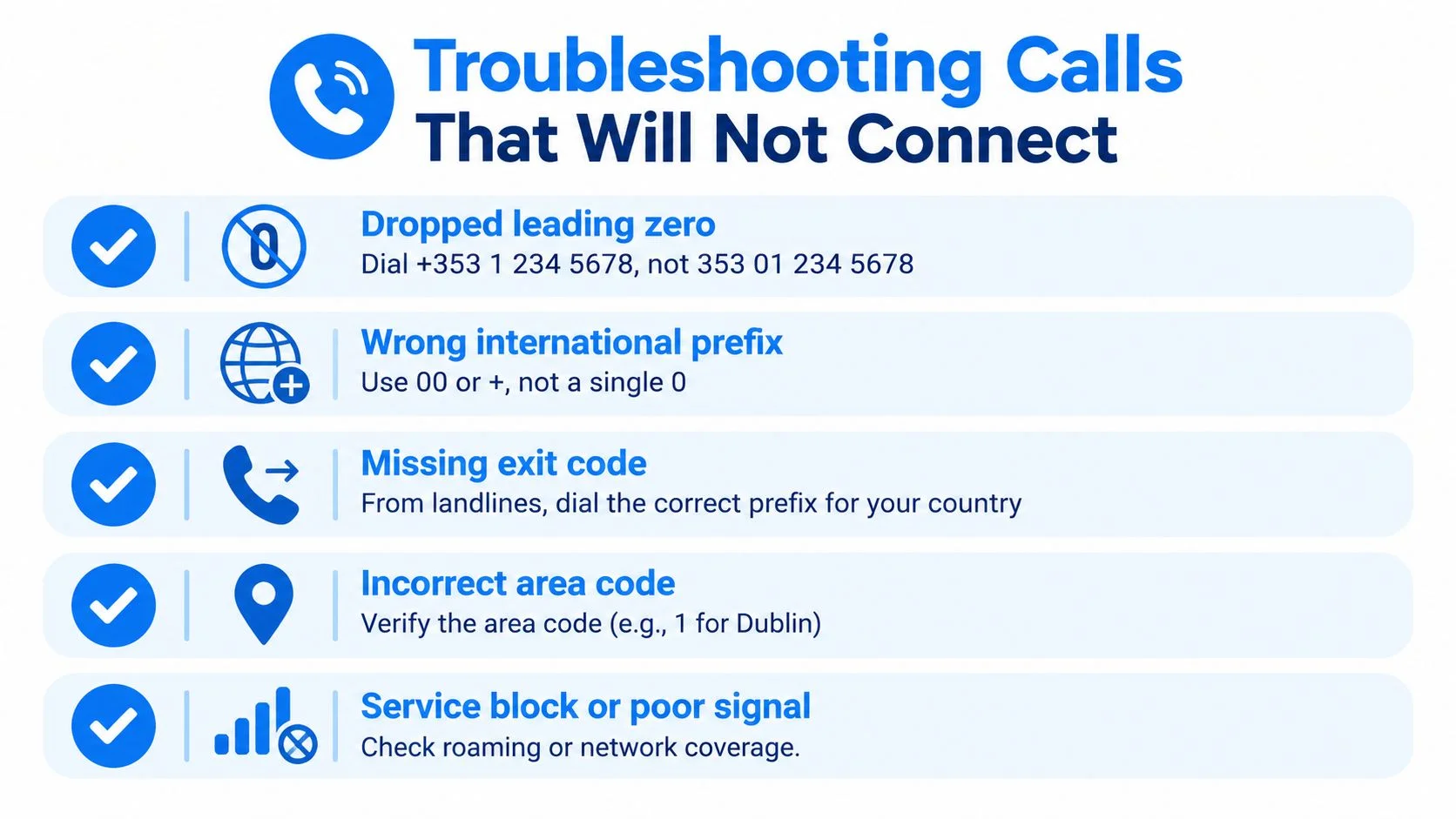
When a call to Ireland fails, the problem is usually formatting, not the phone itself. Check the dial string first, then check the line settings on your device or service.

The most common failures and the fix
- You kept the leading 0: If you dial +353 01 234 5678, that's wrong. Use +353 1 234 5678.
- You used 353 without an exit code on a landline: If your country requires an international prefix, 353 1 234 5678 may fail. Use the proper exit code first.
- You used +353 for Northern Ireland: A Belfast number needs +44, not +353.
- You forgot the exit code from the US or Canada: 01 353 won't work as an international call string. Use 011 353.
- Your line blocks international calls: Some phone services require international dialing to be enabled before the call can leave the country.
- Your device strips the plus sign: Some systems handle + poorly unless the number is stored or converted to a local exit code format.
Fast self-check in under a minute
Run through this list in order:
- Check the destination. Is it the Republic or Northern Ireland?
- Check the first digit of the local number. If it starts with 0 and you're calling the Republic from abroad, remove that 0.
- Check your dialing method. Smartphone with + or landline with the correct exit code.
- Check account permissions. International calling may be disabled.
- Check timing. Repeated ringing with no answer often means bad timing, not a bad number.
A call that rings and isn't answered is a different problem from a call that never routes. Treat those as separate issues.
If you're troubleshooting browser-based or app-based calling specifically, BubblyPhone's guide on why calls fail is a useful checklist for isolating whether the issue is the number, the format, or the connection.
Putting It All Together and Making the Call
The clean formula is easy to remember once you've seen a few examples. Dial exit code + country code + area or mobile code without the leading 0 + subscriber number for the Republic of Ireland.
Two copy-and-use examples
For an Irish mobile, enter +353 87 123 4567 on a modern phone. For a Belfast number from mainland Europe, enter 00 44 28 9012 3456.
For landlines, replace the plus sign with your local international prefix. For smartphones, save the contact in international format and let the phone handle the rest.
The practical way to place the call
If you want to avoid hotel phones, SIM swapping, or local dialing quirks, one straightforward option is to place the call in a browser with BubblyPhone's dialing guide tools. That's especially handy when you need to call a regular landline or mobile and don't want the person receiving the call to install anything.
Once the number is in the right format, the call becomes simple. Most dialing problems come from one wrong prefix, one extra zero, or using +353 when the destination is in Northern Ireland.
If you're ready to place the call, BubblyPhone lets you call from any browser, and the person you're calling doesn't need an app or account. Calling is billed per minute, rounded up to the whole minute, with credits starting at $5 and never expiring.