Call Iran from USA: 2026 Blackout Guide for the 750K Iranian-American Diaspora
Iran's 4+ month internet blackout makes WhatsApp/Telegram useless. Direct-dial PSTN voice is the only working channel. BubblyPhone $0.67/min landline, $0.82/min mobile; calling cards $0.05–0.10/min; avoid carrier pay-per-use at $3–6/min.
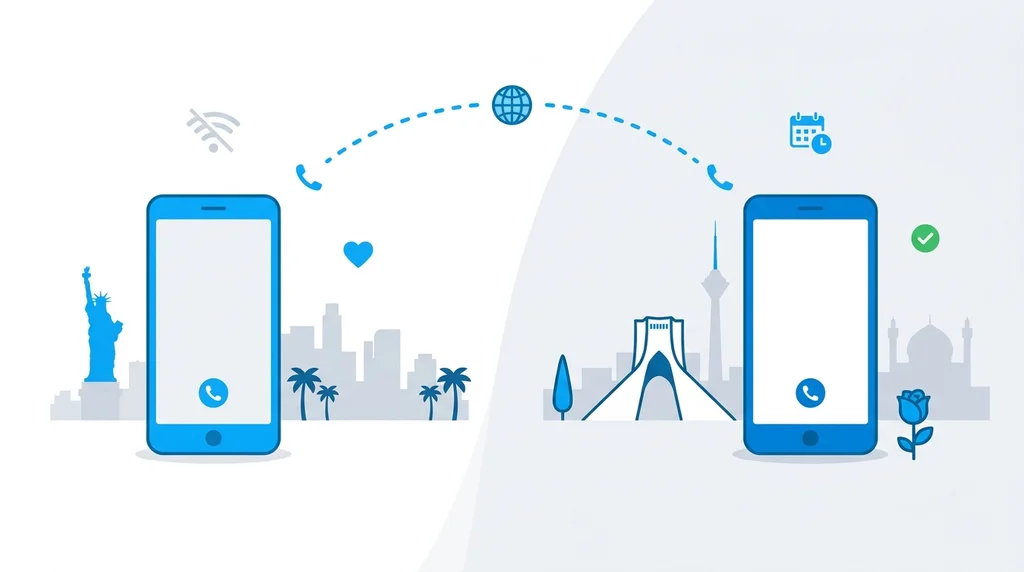
Roughly 750,000 Iranian-Americans (Pew Research, ACS 2024; community estimates 500k–1M+) call home to Iran from the United States — with the largest concentration in “Tehrangeles” (Westwood, Beverly Hills, Brentwood, ~230,000 in LA metro alone), plus DC / Tysons VA, NYC, the Bay Area, and Atlanta. This is the verified May 2026 guide, and it's a different kind of diaspora-corridor article: Iran has been in a near-total internet blackout since 8 January 2026 — over four months and counting, the longest national shutdown ever recorded anywhere in the world. WhatsApp, Telegram, Signal, VPNs, and most internet-routed services are essentially unusable on the Iran end. For Iranian-Americans trying to reach a parent in Tehran or a sibling in Isfahan right now, direct-dial PSTN voice is the only channel that consistently works.
⚡ Quick Answer (May 2026, blackout edition)
Iranian calling cards (IranCalling, Sina, ITM): $0.05–$0.10/min, with access-number dialling and bundle gymnastics.
US-carrier pay-per-use: typically $3–$6/min — avoid.
This article is honest about pricing: BubblyPhone's Iran rates are 6–10x higher than the pennies-per-minute on India or Pakistan corridors because Iranian international termination carries a sanctions-related cost premium. The argument isn't “cheapest” — it's reliable when nothing else is, legal, no PIN, no access number, no monthly subscription. For the duration of the 2026 internet blackout, that combination is uniquely valuable.
📋 Table of Contents
- The 2026 Internet Blackout — What's Happening
- Is It Legal? — OFAC General License D-2
- How to Dial Iran from USA
- Major Iranian Area Codes
- Iranian Mobile Numbers (MCI / Irancell / Rightel)
- 6 Ways to Call Iran in 2026
- Cost Comparison
- Time Zones (IRST UTC+3:30 — the half-hour offset)
- Nowruz & the Persian New Year Call Surge
- Money-Saving Tips
- Common Mistakes to Avoid
- Troubleshooting: Call Not Going Through?
- Frequently Asked Questions
🌐 The 2026 Internet Blackout — What's Happening
On 8 January 2026, Iranian authorities imposed a near-total nationwide internet shutdown. As of this article's May 2026 publication, the blackout has continued for more than four months — the longest sustained national internet shutdown ever recorded anywhere in the world. According to Human Rights Watch and Washington Post reporting, the shutdown has cost the Iranian economy an estimated tens of billions of dollars, eliminated most channels of organising and independent media, and severed effectively all internet-routed communication between Iran and its diaspora.
This sits on top of the longer-running app-blocking pattern that defined the Iran corridor even before 2026:
- Telegram — blocked since April 2018
- Signal — blocked since 2021
- Facebook / Twitter (X) / YouTube — blocked for over a decade
- WhatsApp / Instagram — blocked from September 2022 (Mahsa Amini protests) through 24 December 2024, when the Pezeshkian government formally unblocked them — but throttling and intermittent restrictions continued, and the January 2026 nationwide blackout made the formal unblock moot
- Skype — not blocked, but Microsoft retired Skype globally on 5 May 2025
- Google Voice — over-blocks Iran outbound for most US accounts (Google's caution, not an OFAC requirement)
The compound effect: in May 2026, an Iranian-American calling their grandmother in Mashhad cannot reasonably rely on WhatsApp, Telegram, Signal, Skype, Google Voice, or Facebook Messenger. Direct-dial PSTN voice is what works.
Some context on how we got here: an Israel-Iran “Twelve-Day War” from 13–25 June 2025 included a 60+ hour internet blackout starting 20 June 2025; President Raisi died in a helicopter crash on 19 May 2024; the reformist Masoud Pezeshkian won the runoff election on 5 July 2024 with 53.7% and has periodically signalled openness to internet liberalisation that has not materialised in practice; and the Iranian rial collapsed from roughly 817,000 per USD in January 2025 to approximately 1.47 million per USD by January 2026, with a four-zero redenomination scheduled to begin 21 March 2026 (Nowruz).
⚖️ Is It Legal? — OFAC General License D-2 (Yes, Explicitly)
A real fear among many Iranian-Americans is that calling Iran somehow runs afoul of US sanctions. It does not, for personal communications. The relevant legal authority is OFAC General License D-2, which was permanently incorporated into the Iranian Transactions and Sanctions Regulations at 31 CFR § 560.540 on 17 May 2024. The regulation explicitly authorises:
- Personal phone calls between the United States and Iran (paid or free)
- VoIP services and other internet-based communication services to ordinary Iranians
- Mobile apps and software supporting personal communications
- Hardware and services necessary for personal internet communications
What sanctions do still prohibit: business transactions with sanctioned entities (IRGC, certain banks, certain officials). For the everyday case of calling a relative who is not a sanctioned person and not engaged in sanctioned business, there is no sanctions risk and no reporting requirement. Some US carriers historically over-blocked Iran outbound dialling out of compliance caution, but this has been gradually corrected. Google Voice's continued over-blocking of Iran outbound is a Google decision, not an OFAC requirement.
📞 How to Dial Iran from USA
Standard Format from USA to Iran:
From landline: 011 98 912 123 4567
From landline: 011 98 21 XXXX XXXX
🗺️ Major Iranian Area Codes
📱 Iranian Mobile Numbers (MCI / Irancell / Rightel)
Iran has three licensed mobile operators. As of 2026 the market share split is roughly: MCI 48%, Irancell 46%, Rightel 6%. Mobile Number Portability has been in effect since 2016 — the prefix only suggests the original carrier; subscribers may have ported.
| Prefix range | Carrier | Market share | Dial from USA |
|---|---|---|---|
| 0910–0919 | MCI / Hamrah-e-Aval (state-owned, dominant) | ~48% (~75M) | +98 912 XXX XXXX |
| 0900–0905, 0930, 0933, 0935–0939 | MTN-Irancell (private) | ~46% (~72M) | +98 901 XXX XXXX |
| 0920–0922 | Rightel | ~6% (~9M) | +98 920 XXX XXXX |
Total active mobile subscribers stand at roughly 135–155 million depending on the source — teledensity well over 100% because many Iranians carry multiple SIMs.
🥇 6 Ways to Call Iran from USA in 2026
BubblyPhone — $0.67/min landline, $0.82/min mobile
Browser-based pay-as-you-go calling. Per-second billing, no monthly subscription, no access number, no PIN, no card required at signup. Connects directly to MCI, Irancell, and Rightel mobile, and to Tehran / Mashhad / Isfahan / Shiraz landlines without the recipient needing any app or VPN. Works through the 2026 internet blackout because PSTN voice routes on a different network layer than mobile data.
Honest framing: this is one of BubblyPhone's pricier corridors due to Iran termination economics, but the workflow is the simplest — open the browser, dial. New accounts get their first minute free. Live Iran rates →
Iranian calling cards (IranCalling, Sina Telecom, ITM)
Long-running diaspora calling-card services tuned specifically for the Iran corridor. Per-minute rates typically $0.05–$0.10 to Iran landline, slightly higher to mobile. Popular with older Tehrangeles diaspora and DC-area Iranian-Americans who have used the same card brand for 10+ years.
Trade-off: every call starts with dialling a US access number, then a PIN, then the international number. Bundle math varies month-to-month with promotional minutes. Significantly cheaper per-minute than BubblyPhone; significantly more friction per call.
Rebtel / Mytello / Talk360 — mixed
Per-minute rates to Iran typically $0.15–$0.40 depending on bundle and recipient carrier. App-based; works from iOS and Android with no recipient app required. Quality has historically been inconsistent on the Iran corridor due to termination routing changes.
WhatsApp / Telegram — unreliable in 2026
WhatsApp: formally unblocked in Iran on 24 December 2024 by the Pezeshkian government, but practical reliability never returned to pre-2022 levels — and the January 2026 nationwide internet blackout made the unblock moot. Telegram: still blocked since April 2018, VPN-only. Both apps are effectively unusable for reliable diaspora-to-Iran voice calls in 2026.
If the internet blackout ends, WhatsApp may become usable again for some urban users — but plan for PSTN as the default until further notice.
Google Voice — over-blocks Iran outbound
Google Voice currently refuses Iran outbound for most US accounts. This is Google's own over-blocking out of compliance caution, not an OFAC requirement — General License D-2 explicitly permits personal calls to Iran. Google may relax this in future, but as of May 2026 most attempts fail.
Skype — retired 5 May 2025
Microsoft retired Skype on 5 May 2025. The Iran corridor was hit particularly hard because many Iranian-Americans had used Skype credit specifically becausemessaging apps don't work into Iran — Skype was the workaround. Teams Free doesn't replace the credit-callable-out workflow. BubblyPhone is the closest shape-for-shape replacement.
💵 Cost Comparison (USA → Iran Mobile)
| Method | Per-min | Works during 2026 blackout? | Friction |
|---|---|---|---|
| BubblyPhone | ~$0.82 | ✓ Yes (PSTN) | Browser, no PIN, no access number |
| Iranian calling cards | $0.05–$0.15 | ✓ Yes (PSTN) | Access number + PIN per call |
| Rebtel / Mytello / Talk360 | $0.15–$0.40 | ⚠ Mostly (PSTN termination) | App install |
| WhatsApp / Telegram | Free | ✗ No (blackout) | Recipient needs working internet |
| Google Voice | N/A | ✗ Over-blocked | Refused for most accounts |
| Skype | N/A | ✗ Retired 5 May 2025 | — |
| Verizon / AT&T pay-per-use | ~$3–$6 | ✓ Yes (PSTN) | No setup; price is brutal |
On per-minute price alone, Iranian calling cards win. On reliability-plus-workflow, BubblyPhone wins — especially for callers who don't have a card already and want to dial a relative right now without the PIN-and-access-number flow. The honest comparison: a 30-minute call costs roughly $2.40 on a calling card and $24.60 on BubblyPhone; the same call costs $90–$180 on Verizon pay-per-use and doesn't connect at all through WhatsApp or Telegram during the 2026 blackout.
🕒 Time Zones — IRST UTC+3:30 (The Half-Hour Offset)
Iran runs on Iran Standard Time (IRST, UTC+3:30) — one of only a handful of timezones in the world with a half-hour offset. Iran abolished daylight saving time on 21 September 2022, so since then IRST is permanent year-round with no spring/fall shift. From the US, the gap depends on your time zone and whether US DST is active:
- Eastern (NYC, DC, Atlanta): Iran is +8.5 hours in winter (EST), +7.5 hours in summer (EDT)
- Central (Chicago, Houston, Dallas): +9.5 / +8.5 hours
- Mountain (Denver, Phoenix): +10.5 / +9.5 hours
- Pacific (LA — the Tehrangeles call corridor): +11.5 hours in winter, +10.5 hours in summer
Practical sweet spot from Tehrangeles: 7am–10am US Pacific = roughly 6:30pm–9:30pm Tehran — your relative is home from work, you're starting your day, and Tehran evening congestion (worst 9–11pm local) hasn't fully set in. From the East Coast: 10am–1pm US Eastern = 6:30pm–9:30pm Tehran. The half-hour offset is a recurring stumbling block — many missed calls on this corridor are 30-minute time-conversion errors.
🌱 Nowruz & the Persian New Year Call Surge
Nowruz — Persian New Year — falls on the vernal equinox, around 20–21 March each year. For Iranian-Americans, the days just before, during, and just after Nowruz are the most call-intensive of the year. Family members exchange greetings at the exact moment of the equinox (Tahvil), and extended family hold long voice calls over the 13-day Nowruz holiday period.
Three Nowruz-specific tips: (1) top up your BubblyPhone balance or buy your calling card in advance — high demand sometimes causes momentary friction in payment processing on Nowruz eve. (2) Tahvil time is broadcast in IRST and converted by Iranian-American media outlets — double-check the half-hour offset before you dial at the exact moment. (3) Nowruz 2026 also coincides with the start of the four-zero rial-to-toman redenomination on 21 March 2026 — family conversations may include some confusion about price quotes for weeks afterwards.
💡 Money-Saving Tips for the Iran Corridor
- Default to PSTN, not apps. During the 2026 internet blackout, WhatsApp / Telegram / Signal are not viable. BubblyPhone or a calling card.
- For high-volume callers (weekly hour-long parent calls), an Iranian calling card is meaningfully cheaper per minute than BubblyPhone — if you don't mind the access-number + PIN workflow. For occasional or low-friction-preferred callers, BubblyPhone wins on workflow.
- Always confirm time references in IRST 24-hour notation. “Call me at 9 my time” with the half-hour offset is a recipe for missing the call by 30 minutes.
- Save numbers in international format. Use +98 912 ... rather than 0912 ... — works from any country and eliminates the leading-0 failure mode.
- For Tehrangeles callers, the 7am–10am US Pacific window is the sweet spot — you're up, Iran is in the evening.
- Stop relying on VPN-WhatsApp. Even before the 2026 blackout, VPN reliability into Iran had been collapsing since the 2024 VPN-crackdowns. PSTN is the durable answer.
- Voice-verify any financial coordination. Iranian-American families managing remittances, real-estate, or inheritance often coordinate by voice — direct-dial PSTN is harder to spoof than messaging-app voice and is fully legal under OFAC GL D-2.
❌ Common Mistakes to Avoid
- Worrying that calling Iran is illegal. It isn't. OFAC General License D-2 (codified at 31 CFR § 560.540 since 17 May 2024) explicitly authorises personal communications between the US and Iran.
- Forgetting the half-hour IRST offset. Iran is at UTC+3:30, not UTC+3 or +4. Many missed Nowruz Tahvil moments and birthday calls are 30-minute conversion errors.
- Forgetting Iran abolished DST in 2022. Some old time-conversion tools still assume Iran observes spring-forward / fall-back. It doesn't since 21 September 2022.
- Keeping the leading 0. 0912-123-4567 becomes +98 912 123 4567 from the US — the 0 drops.
- Trying Google Voice. It over-blocks Iran outbound. Don't waste minutes on a method that's known to fail.
- Assuming WhatsApp/Telegram work because they did pre-2026. The January 2026 nationwide blackout made all internet apps non-functional. Plan for PSTN until the blackout ends.
- Confusing toman with rial. Official currency is rial; most Iranians speak in tomans (1 toman = 10 rials, historically). On 21 March 2026 the rial-to-toman redenomination begins, dropping four zeros. Expect lingering confusion in family conversations.
🛠️ Troubleshooting: Call Not Going Through?
Symptom: WhatsApp / Telegram won't connect at all.
Expected behaviour in 2026. The nationwide internet blackout since 8 January 2026 has severed essentially all internet-routed voice on the Iran end. Switch to BubblyPhone or a calling card.
Symptom: “Number cannot be reached.”
Three common causes: (1) you kept the leading 0 in the international number; (2) the recipient's SIM was deactivated under MCI/Irancell SIM-registration rules; (3) your VoIP provider has temporary Iran termination issues. Try BubblyPhone if you were on a card, or vice versa.
Symptom: Google Voice refuses to dial.
Known issue. Google Voice over-blocks Iran outbound for most US accounts. There is no workaround within Google Voice — use BubblyPhone or a calling card instead.
Symptom: Endless ringing.
Time-zone math — Iran is 7.5–11.5 hours ahead of the US depending on your time zone, with a half-hour offset that's easy to miscalculate. Best window: 10am–1pm US Eastern or 7am–10am US Pacific = 6:30pm–9:30pm Tehran.
Symptom: US carrier says “cannot complete call.”
Some US carriers historically over-blocked Iran outbound. This is gradually being corrected, but if your direct-from-phone call to +98 fails, switch to BubblyPhone's browser dialler — it bypasses your US carrier's international routing.
Ready to call Iran?
First minute free. No card required. Browser-based dialler, no app to install, no PIN, no access number. Works during the 2026 internet blackout because PSTN voice routes around mobile-data outages. Fully legal under OFAC General License D-2. Live Iran rates.
Try BubblyPhone — first minute free❓ Frequently Asked Questions
Is it legal for an American to call Iran in 2026?
What is the 2026 Iran internet blackout?
Why doesn't Google Voice work for calling Iran?
How do I dial an Iranian mobile number from the USA?
What is the time difference between USA and Iran?
Why is BubblyPhone's Iran rate higher than India or Pakistan?
What about Nowruz — will I be able to call family on Persian New Year 2026?
What happened to Skype for calling Iran?
When does it make sense to use BubblyPhone vs an Iranian calling card?
What's happening with the Iranian currency and how does it affect family calls?
Related Resources
Call Iran from Abroad (Worldwide)
Multi-country origin guide for the Iran corridor
Call India from USA
Sister diaspora corridor with +91 reference
Call Pakistan from USA
Sister diaspora corridor with +92 reference
Call Bangladesh from USA
Sister diaspora corridor + the IMO twist + 2024 blackout
BubblyPhone Rates
Per-minute rates worldwide, no subscription, a free first minute
Start Calling
Sign up, make your first minute free, start dialing in under 60 seconds