Area Code 516 Guide for Nassau County New York
Table of Contents
- A practical way to read the guide
- The 1999 split
- The 2023 overlay
- Why the code doesn't identify one town
- How to interpret a number
- 516 and 363 side by side
- What this means for number planning
- Calling from inside Nassau County
- Calling from elsewhere in the United States
- Calling from abroad
- A resident calling a neighbor
- A business choosing a local identity
- An expat calling family in Nassau
- A support team returning a call
- Check the claim, not just the code
- When a call fails
- Core facts
- Three terms to remember
Area code 516 serves all of Nassau County on Long Island, New York, and now shares that exact footprint with overlay 363, which means local callers must use 10-digit dialing. The practical question isn't only where 516 is located. It's how the overlay changes number availability, dialing habits, and the way businesses and families handle callbacks.
What Area Code 516 Covers and How to Use This Guide
Area code 516 is the Nassau County numbering plan area on Long Island, New York, and it now shares that footprint with overlay 363. That means the code tells you more about dialing rules and number availability than about a single town. The New York Department of Public Service confirms that 516 serves Nassau County and that 363 applies to the same area (official Nassau County overlay information).
For callers and businesses, that matters in a few practical ways. A 516 number can still point to Nassau County, but so can a 363 number. If you are checking caller ID, assigning a business line, printing contact details, or placing a call from outside the United States, the main questions are:
- Geography: Does the number belong to Nassau County or another area?
- Numbering: Is it part of the older 516 pool or the newer 363 overlay?
- Dialing: What format should you use from Nassau County, elsewhere in the United States, or another country?
A practical way to read the guide
Start with the geography section if you want the county covered by 516. It explains why 516 is a county-wide numbering plan area, or NPA, rather than a city code, and why rate centers matter for routing and provisioning.
The history section shows how Suffolk County moved out of 516. The overlay section then explains why 516 and 363 now sit on the same county footprint, while the dialing section gives the formats you can use right away.
Later sections focus on actual tasks. You'll see examples for residents, businesses, overseas callers, and support teams, plus a verification checklist for outdated listings and calls that fail when seven-digit dialing is used. Readers comparing numbering plans can also review the 832 area code for sales teams as a practical reference.
Practical rule: Treat 516 as a Nassau County identifier, then check whether the number is assigned under 516 or 363 before you assume anything about dialing.
How Area Code 516 Has Changed Over Time
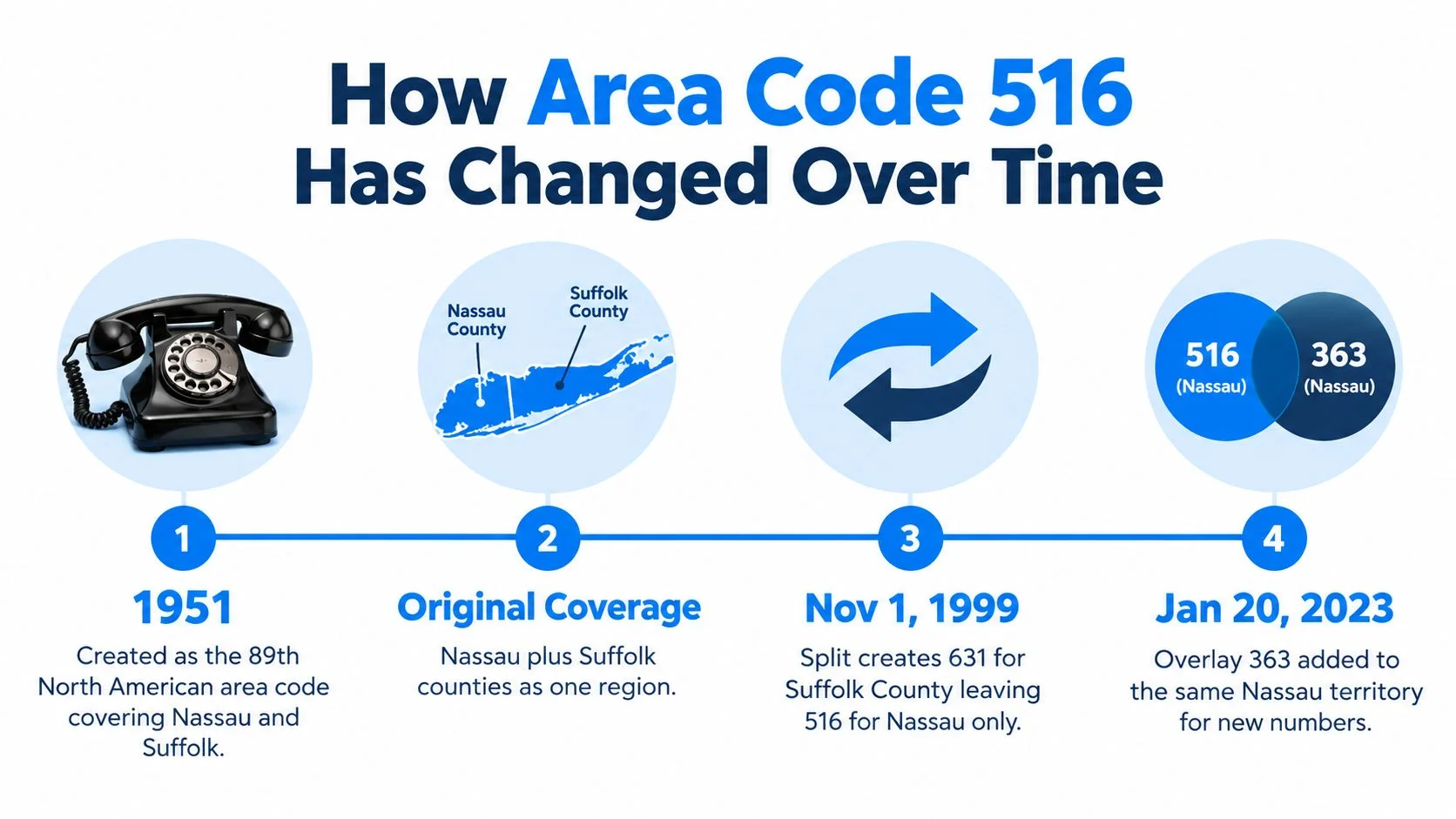
Area code 516 began in 1951 as a shared code for Nassau and Suffolk counties. It was one of only 2 new area codes introduced that year and the 89th area code placed into service in North America (history of area codes 516 and 363).
That original setup treated Long Island's two counties as one numbering plan area. As demand for phone numbers grew, administrators had to add capacity and redraw the numbering map.

The 1999 split
On November 1, 1999, Suffolk County was split from 516 and assigned area code 631. From that point on, 516 covered Nassau County only. Callers did not have to change everything at once. Permissive dialing for the old arrangement continued into spring 2000, which gave residents and businesses time to update records, stationery, directories, and stored contacts (area code history and split details).
That split created a cleaner rule of thumb. Nassau became associated with 516, and Suffolk with 631. The rule still helps, but it is only part of the story, because Nassau now uses a second code as well.
The 2023 overlay
On January 20, 2023, 363 was added as an overlay for the same Nassau County footprint. An overlay adds numbering capacity without carving the county into a separate geographic zone. New lines can receive either 516 or 363, and both codes point to the same service area. For the official notice, refer to the New York Department of Public Service announcement linked above.
That move fits Nassau's numbering needs. The county has a relatively small land area and a large population, which puts steady pressure on available numbers (Nassau County area code overview). In practical terms, that is why the solution was a second code, not a new county boundary.
The takeaway is straightforward. 516 still works, but it is no longer Nassau County's only active code. The overlay also made 10-digit local dialing mandatory, so the main change for callers is dialing behavior and number availability, not just geography.
Where Area Code 516 Serves Today
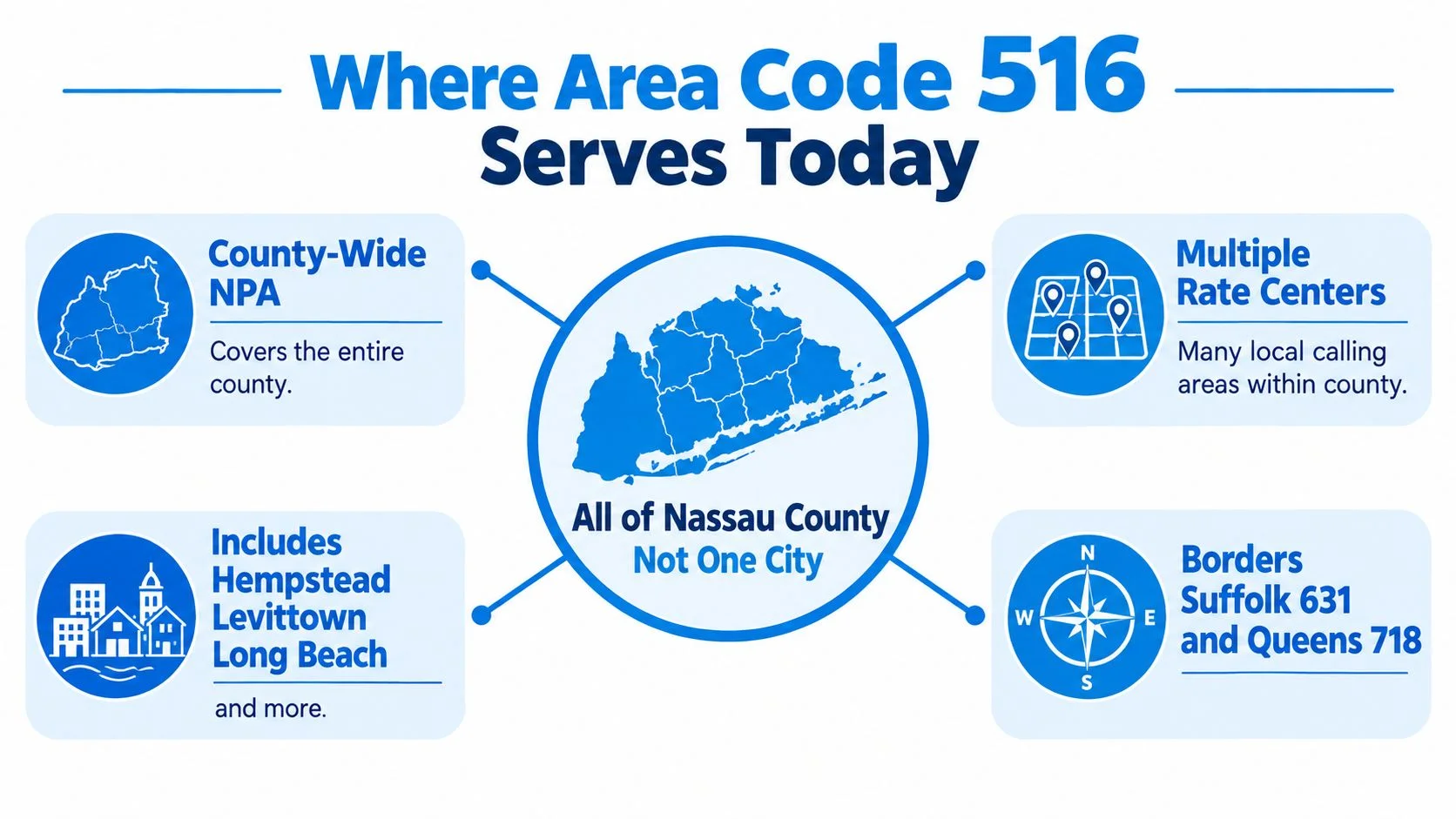
Area code 516 serves all of Nassau County, not one primary city. It covers the county-wide footprint on Long Island, and 363 uses the same footprint. Communities often associated with the code include Hempstead, Levittown, Freeport, Garden City, Great Neck, Long Beach, Rockville Centre, and Mineola.

Why the code doesn't identify one town
An area code sets a broad numbering area. Inside 516, the local rate centers are spread across several exchange zones, including Nassau Zone 2, Nassau Zone 4, Nassau Zone 5, and Nassau Zone 7, along with related exchanges (516 exchange and rate-center listings).
That structure matters when a team assigns direct inward dialing, routes calls, or checks local calling scope. The area code alone does not identify a carrier, a single exchange, or one exact rate center. A 516 number can point to different local exchange assignments across the county.
How to interpret a number
A business number beginning with 516 is a Nassau County number, but it does not tell you whether the business sits in Hempstead, Mineola, or somewhere else. Number portability, remote work, call forwarding, and hosted phone systems can separate the number from the caller's current location.
The same logic applies to 363. It shares the Nassau County footprint, so the code points to the same general service area even if the assignment is newer.
To check a number before calling or saving it, use BubblyPhone's area code lookup tool. Treat the result as a starting point, not proof of a person's location or identity.
Understanding the 363 Overlay and Number Availability
The 363 overlay has served the same Nassau County territory as 516 since January 20, 2023. New numbers may receive either code, so 516 and 363 now identify one shared geographic footprint rather than two separate Nassau regions.

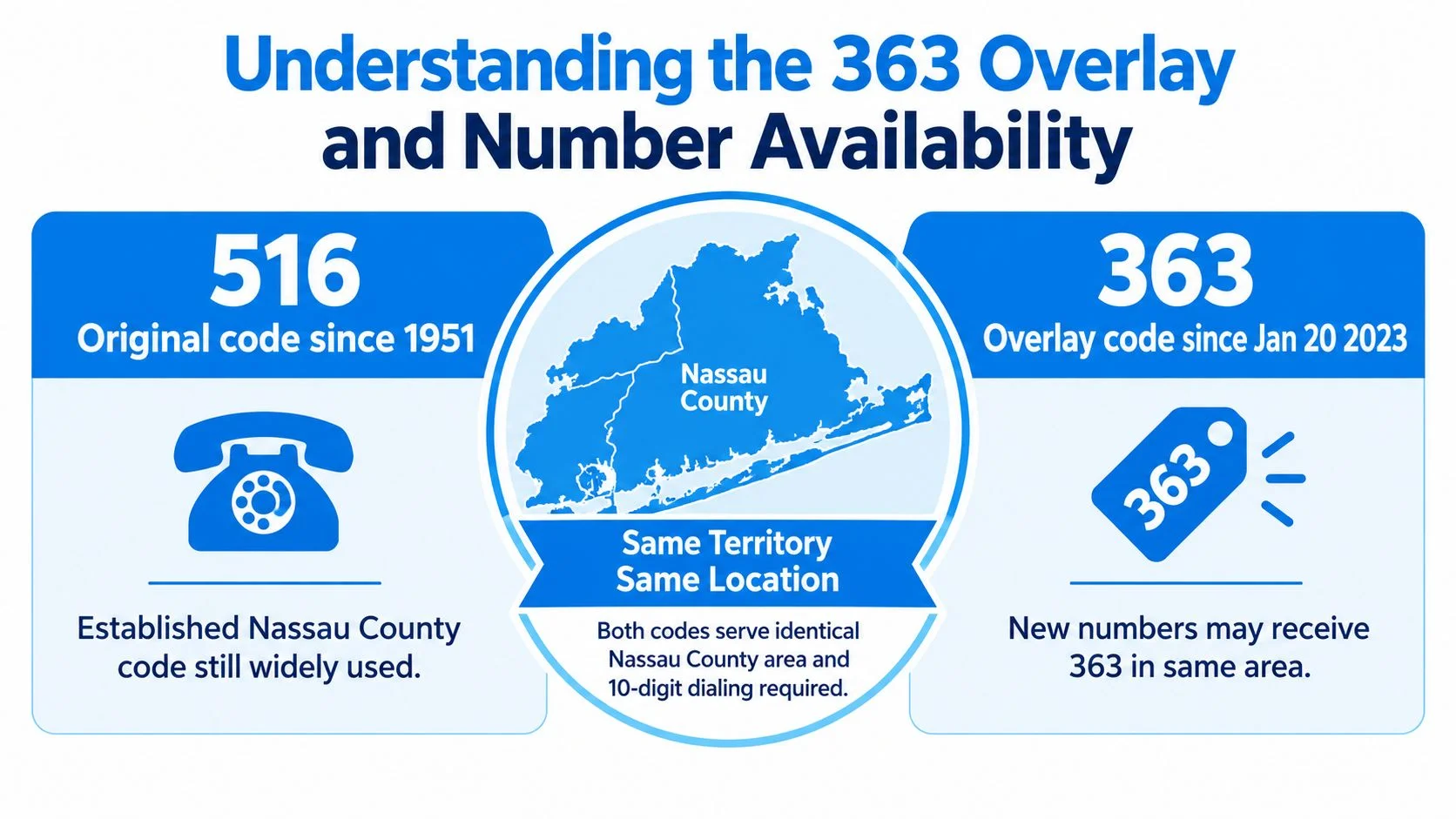
Before the overlay, “516” was a strong shorthand for Nassau County because it was the county's established code. After the overlay, that shorthand is only partly useful. A 363 number can belong to the same county, serve the same kind of customer, and work within the same local calling area.
516 and 363 side by side
The codes can signal different assignment vintages. A long-established resident, institution, or business may have a 516 number, while a newer line may receive 363. That difference can affect memorability and customer expectations, but it doesn't create a different Nassau County service area.
What this means for number planning
A small business choosing a local presence number should decide whether the priority is a memorable sequence, continuity with an existing number, or a recognizable Nassau identity. It shouldn't reject 363 because it isn't 516. Both codes can present the same county-wide local identity.
Travelers and expats face a similar issue. If family members say they have a “Nassau number,” ask for the complete 10-digit number, including 516 or 363. The area code is now essential because seven digits alone don't distinguish the two overlays reliably.
Support teams should save the full number exactly as received. A callback to a 363 number shouldn't be changed to 516 based on an assumption that 516 is the “real” Nassau code. The correct code is the one assigned to that specific line.
How to Dial Area Code 516 Numbers Correctly
Use 10 digits for every local call to a 516 or 363 number within Nassau County. Dial the area code plus the seven-digit local number, because the overlay makes seven-digit local dialing insufficient (mandatory 10-digit dialing notice).
Use the following formats. The sample local number is illustrative and isn't a real contact.
Calling from inside Nassau County
Don't dial only 555-0148. Enter the complete 516-555-0148 or 363-555-0148, depending on the number you received. If your phone displays a local contact without the area code, edit the saved record before calling.
This matters for both people and systems. Printed directories, website contact pages, customer relationship records, and callback buttons should store the full number. A seven-digit format may look familiar, but the overlay requires the area code.
Calling from elsewhere in the United States
From another US state, use the national prefix 1 followed by the area code and local number. Many mobile phones accept the 10-digit version without the leading 1, but 1-516-555-0148 is the clear domestic long-distance format.
If you're unsure whether the recipient has 516 or 363, don't guess. Check the complete number in the original message, voicemail, invoice, or contact record.
Calling from abroad
International callers should use the country's exit procedure followed by 1, the relevant area code, and the seven-digit number. The compact international notation is +1 516 555 0148, or +1 363 555 0148 for a 363 line.
For browser-based international calling, BubblyPhone's dialing guide can help you confirm the country-code format before you place the call.
Common Caller Scenarios and Practical Examples
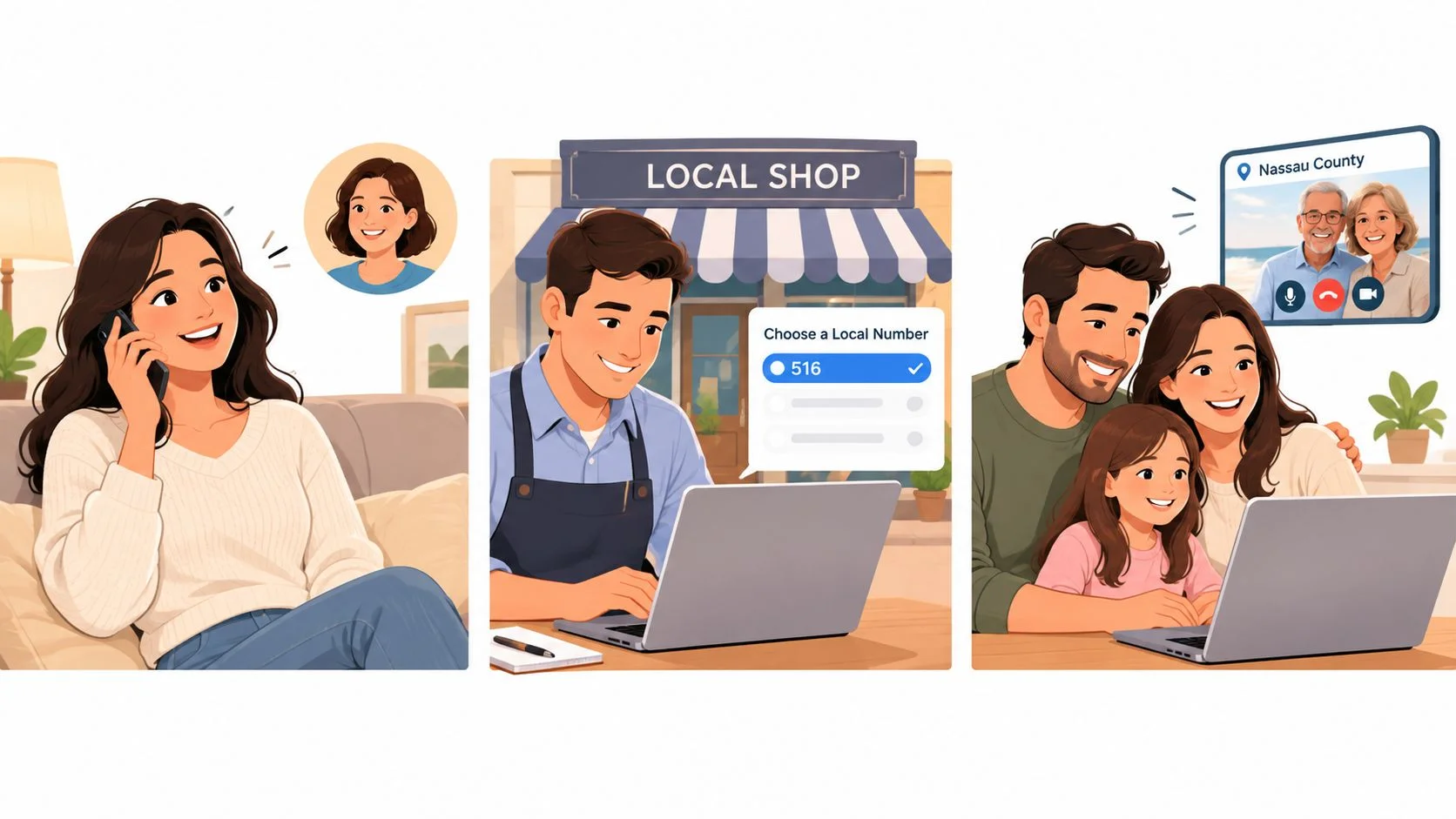
Residents, businesses, overseas relatives, and support teams should all treat 516 and 363 as complete 10-digit numbers. The codes point to the same Nassau County footprint, but the assigned code can differ from one line to another.

A resident calling a neighbor
A Nassau resident sees a number written as 516-555-0148. The correct local entry is the full 10-digit number, not only 555-0148.
“Is this the number you want me to use for callbacks?”
“Yes. Save it with 516 included.”
That small habit prevents failures when contacts move between devices or when a phone system enforces the overlay's dialing rules.
A business choosing a local identity
A company serving Nassau County may want a local number for its website, invoices, or customer service queue. It can consider both 516 and 363 because both codes represent the county-wide footprint. The important checks are number availability, memorability, ownership or porting requirements, and whether every public contact point displays all 10 digits.
A 363 number isn't evidence that the business serves a different county. It may be a newer assignment.
An expat calling family in Nassau
Someone abroad should ask for the full number in international form, such as +1 516 555 0148. If the relative has a 363 line, replace 516 with 363 rather than assuming every Nassau number begins with 516.
Browser calling can be useful when the recipient uses an ordinary landline or mobile. BubblyPhone works in a browser, and the person receiving the call doesn't need an app or account. Check the live Gini Help blocks 662 spam resource when you're also evaluating unfamiliar caller IDs, but don't treat any area code alone as proof that a call is safe or fraudulent.
A support team returning a call
A support agent should copy the caller's complete number into the callback field. If the displayed number is 363-555-0148, returning the call to a guessed 516 equivalent can reach the wrong line or fail altogether.
Callback rule: Preserve the original area code, use all 10 digits, and verify the contact through the customer record before discussing account details.
Spotting Misleading Information and Verifying a 516 Number
A page that calls 516 Nassau County's sole area code is outdated. Since the 363 overlay was introduced, both codes share the Nassau County footprint, and local calls require 10-digit dialing.
Check the claim, not just the code
Population pressure helps explain why the overlay was needed. Nassau County has a land area of 287 square miles, a population of about 1.36 million in 2017, and density above 4,700 people per square mile according to independent summaries (Nassau County area code details). Those conditions create pressure on available numbering resources, but they don't tell you who owns a particular number.
Use this verification sequence before printing a number, provisioning a line, or returning an unexpected call:
- Confirm the area code. It should be 516 or 363 for a Nassau County identity.
- Check the full number. Seven digits aren't enough for reliable dialing in the overlay region.
- Verify the current overlay status. Prefer the New York Department of Public Service notice over an old directory entry.
- Check technical details when needed. Rate-center records can show exchange assignments, but an NPA alone doesn't identify a carrier or exact rate center.
- Validate the caller separately. Caller ID can be spoofed, so confirm sensitive requests through an established contact channel.
For a broader overview of phone-number checks, you can also review Pipecorn's verification guide. It should supplement, not replace, direct confirmation with the person or organization involved.
When a call fails
If a local call fails after dialing seven digits, add the area code and try again. Use the assigned code, either 516 or 363, rather than choosing one based on the recipient's town.
For a lookup workflow, the reverse phone lookup tool can help organize initial checks. Don't use a lookup result as permission to disclose private information, and don't infer a caller's exact location from the area code.
A reliable number record should include the complete international format, for example +1 516 555 0148, along with the date and source where you obtained it. That format remains clear when the contact is shared across countries, devices, or support systems.
Quick Reference for Area Code 516
What does area code 516 tell you? In Nassau County, it is only part of the answer, because 516 and 363 now share the same footprint. The task is dialing correctly and checking which numbers are available.
Core facts
- Service area: Nassau County, New York.
- Original history: Created in 1951 as the 89th area code placed into service in North America.
- Earlier footprint: Nassau and Suffolk counties originally shared 516.
- County split: Suffolk moved to 631 on November 1, 1999.
- Current overlay: 363 was added to the same Nassau County territory on January 20, 2023.
- Local dialing: Use the area code plus the seven-digit number.
- Geographic meaning: 516 or 363 can indicate Nassau County, but neither code identifies one city, carrier, or precise rate center.
Three terms to remember
NPA means numbering plan area. It is the technical category behind an area code, and it can cover a county-wide territory rather than a single municipality.
Overlay means that two area codes serve the same geographic footprint. In Nassau County, 516 and 363 share the same territory instead of splitting the county into separate code zones.
10-digit dialing means entering the area code and seven-digit local number even for a local call. Examples include 516-555-0148 and 363-555-0148.
Keep the full number in your contacts, advertisements, invoices, and callback systems. If a source says 516 is the only Nassau County code, the official overlay notice is linked in the history section above. For international calling, consult live rates at BubblyPhone rates, since pricing can change by destination and number type. Consult the live New York Department of Public Service notice rather than an old directory entry.