Call Barring Meaning (2026)
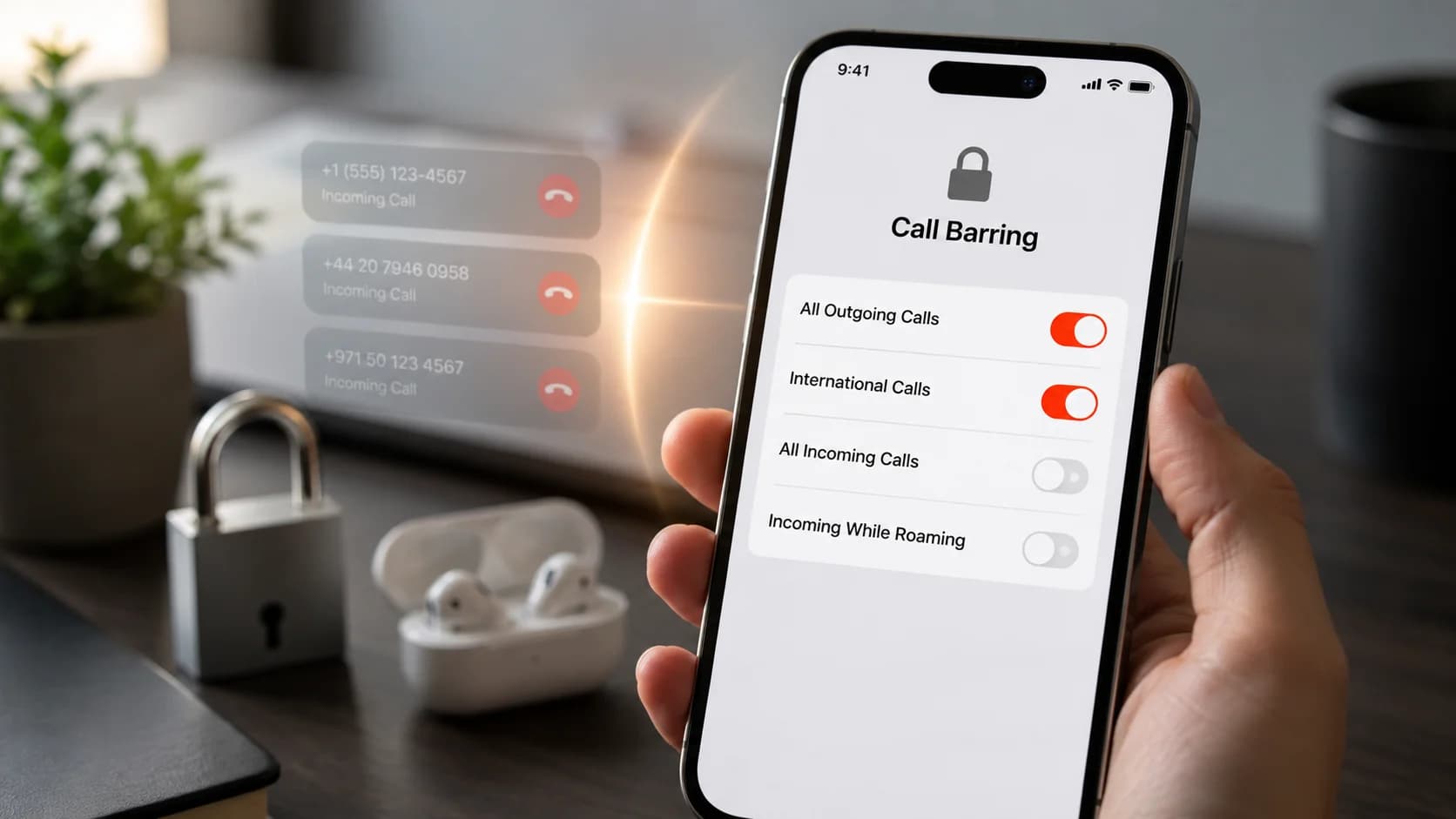
Table of Contents
- Quick definition
- Simple example
- Where users encounter this
- Why it matters
- Call barring vs call blocking vs call forwarding
- Call barring
- Call blocking
- Call forwarding
- Common types of call barring
- Incoming call barring
- Outgoing call barring
- Common problems and misunderstandings
- Mistaking it for spam protection
- Thinking it blocks only one person
- Forgetting the barring password
- Assuming every phone supports it the same way
- Assuming it will work perfectly abroad
- How to fix or use it well
- If you still need to place a call
- Related guides
- FAQ
- What does call barring mean on my phone?
- Is call barring the same as blocking a contact?
- Is call barring the same as call forwarding?
- Can emergency calls still work when call barring is on?
- Why does call barring matter when roaming?
- Why can I still make some calls even though barring is on?
- Final take
People usually search for call barring meaning when a phone suddenly says calls are barred, international calls stop working, or a settings menu shows terms that sound more technical than they need to be.
The simplest definition is this: call barring is a network or line-level feature that restricts categories of incoming or outgoing calls.
It does not usually mean you blocked one person manually. It means the phone line, SIM, or carrier setting is set to stop a type of call such as international outgoing calls, all incoming calls while roaming, or all outgoing calls altogether.
Quick definition
Call barring is a telecommunications feature that lets you block certain types of calls from being made or received.
EE defines it as a way to block incoming, outgoing, and international calls at home or abroad. Samsung describes it as a feature that lets you stop incoming and outgoing calls on a Galaxy phone, with different settings for the kinds of calls you want to allow or bar.
The most important word in the definition is types.
Call barring usually works at the category level, not the individual-contact level.
Simple example
Imagine you are traveling outside your home country and do not want surprise charges.
You might turn on:
- incoming calls while roaming, so your phone will not accept normal inbound voice calls abroad
- outgoing international calls, so nobody using the line can place expensive international calls from that SIM
That is call barring.
Another example: a parent or business owner might bar premium-rate or international outgoing calls on a shared line to avoid misuse.
Where users encounter this
People usually run into call barring in one of these situations:
- while roaming abroad and trying to control costs
- on shared family or office lines
- on dual-SIM phones where one SIM is work-only
- when trying to stop international or premium-rate calling
- when a phone says calls are restricted or barred and the user is not sure why
KCOM’s business call-barring guide is useful here because it shows how carriers often split the feature into incoming and outgoing barring, with outgoing barring then broken into categories like local, national, international, operator, or premium-rate calls.
Why it matters
Call barring matters because it solves a different problem than ordinary call blocking.
It helps with:
- cost control: blocking international, roaming, or premium-rate call categories
- access control: stopping certain kinds of calls on work, family, or shared lines
- travel management: reducing unwanted roaming voice activity
- focus and availability: preventing calls on a line or SIM when you do not want it used
EE also notes an important limitation: not all foreign networks support call barring consistently while you are abroad. That means the feature can be useful, but it is not always perfect in every roaming situation.
Call barring vs call blocking vs call forwarding
This is where most articles get fuzzy, so here is the clean version.
Call barring
Blocks a category of calls on the line or SIM.
Examples:
- all outgoing calls
- all incoming calls
- outgoing international calls
- incoming calls while roaming
Call blocking
Blocks a specific caller or number.
If you block one spammer or one contact, that is not standard call barring. Apple’s iPhone support documents and Android phone settings treat blocked contacts as a separate feature.
Call forwarding
Redirects calls somewhere else instead of barring them.
If a call goes straight to another number or voicemail, that is usually a forwarding or routing issue, not barring. For that side of the problem, Call Forwarding Codes and Stop Call Forwarding are better references.
Common types of call barring
The specific names vary by carrier and phone, but the main types are usually familiar.
Incoming call barring
This stops certain incoming calls.
Common versions include:
- all incoming calls
- incoming calls while roaming
Outgoing call barring
This stops certain outgoing calls.
Common versions include:
- all outgoing calls
- international outgoing calls
- international outgoing calls except home country
- premium-rate or operator/service-code calls on some carriers
Samsung’s and Vodafone’s device guides show these categories in normal phone settings, while KCOM and EE show how carriers can also control them at the service level.
Common problems and misunderstandings
Mistaking it for spam protection
Call barring is not a full anti-spam system.
If your goal is to stop one nuisance number, use a blocked-number or caller-identification feature instead. Anonymous Calls is a better starting point for that topic.
Thinking it blocks only one person
It usually blocks a class of calls, not one caller.
Forgetting the barring password
This is one of the biggest practical issues. Samsung says some devices may accept 0000 as the barring password, while Vodafone device guides commonly show 1919 as the default on supported phones. In real life, defaults vary by carrier and device.
Assuming every phone supports it the same way
Samsung explicitly notes that some providers do not offer the feature in the same way, which is why some users do not even see the call-barring menu.
Assuming it will work perfectly abroad
EE warns that not all foreign networks support call barring, so some roaming behavior can still be inconsistent.
How to fix or use it well
If you actually want to use call barring intentionally, keep it simple.
- Choose the exact category you want to restrict instead of turning everything off or on blindly.
- Check which SIM you are editing on a dual-SIM phone.
- Confirm whether your carrier actually supports the feature on your device.
- Keep track of the barring password or PIN.
- If you forgot the password, contact the carrier instead of guessing repeatedly.
If you are trying to remove it because calls are failing, the first step is to confirm that the issue is really barring and not forwarding, blocked numbers, or a more general network problem. Why Calls Are Failing is the best live troubleshooting page for that.
If you still need to place a call
BubblyPhone does not turn carrier call barring off. If your SIM or carrier line is barred, you still need to fix that with the phone or provider.
Where BubblyPhone can help is as a practical workaround if your normal voice line is restricted but you still have Wi-Fi or mobile data and need to place a call anyway, especially an international one. Because it is browser-based, it avoids the extra monthly-plan problem too: you top up credit when you need it, your credit does not expire, and you are not paying the same subscription price in quiet months.
For that route, WiFi Calling Apps and Cheap International Calls are the most useful next reads.
Related guides
FAQ
What does call barring mean on my phone?
It usually means your line, SIM, or carrier settings are blocking a category of calls, such as all outgoing calls or international calls.
Is call barring the same as blocking a contact?
No. Blocking a contact is person-specific. Call barring usually blocks a class of calls.
Is call barring the same as call forwarding?
No. Call forwarding redirects calls. Call barring restricts them.
Can emergency calls still work when call barring is on?
On many carrier implementations, yes. EE says you can still dial emergency numbers like 112 and 999, and KCOM’s guide also notes emergency access remains available in certain barring setups. But carrier rules can vary, so check your provider.
Why does call barring matter when roaming?
Because one of its common uses is stopping incoming or outgoing calls while abroad to reduce unexpected roaming-related voice charges.
Why can I still make some calls even though barring is on?
Because the wrong category may be barred, the roaming network may not support the feature fully, or the restriction may not be applied the way you expect on that carrier.
Final take
The easiest way to understand call barring is this: it is a category-level call restriction, not a contact-level block.
If you remember that one distinction, most of the confusing menu labels make more sense. It is there to control types of calls, usually for cost, travel, or access-control reasons. If the setting appears unexpectedly, think carrier or SIM rules first, not just a random phone bug.