Area Code 844 Scams (2026)
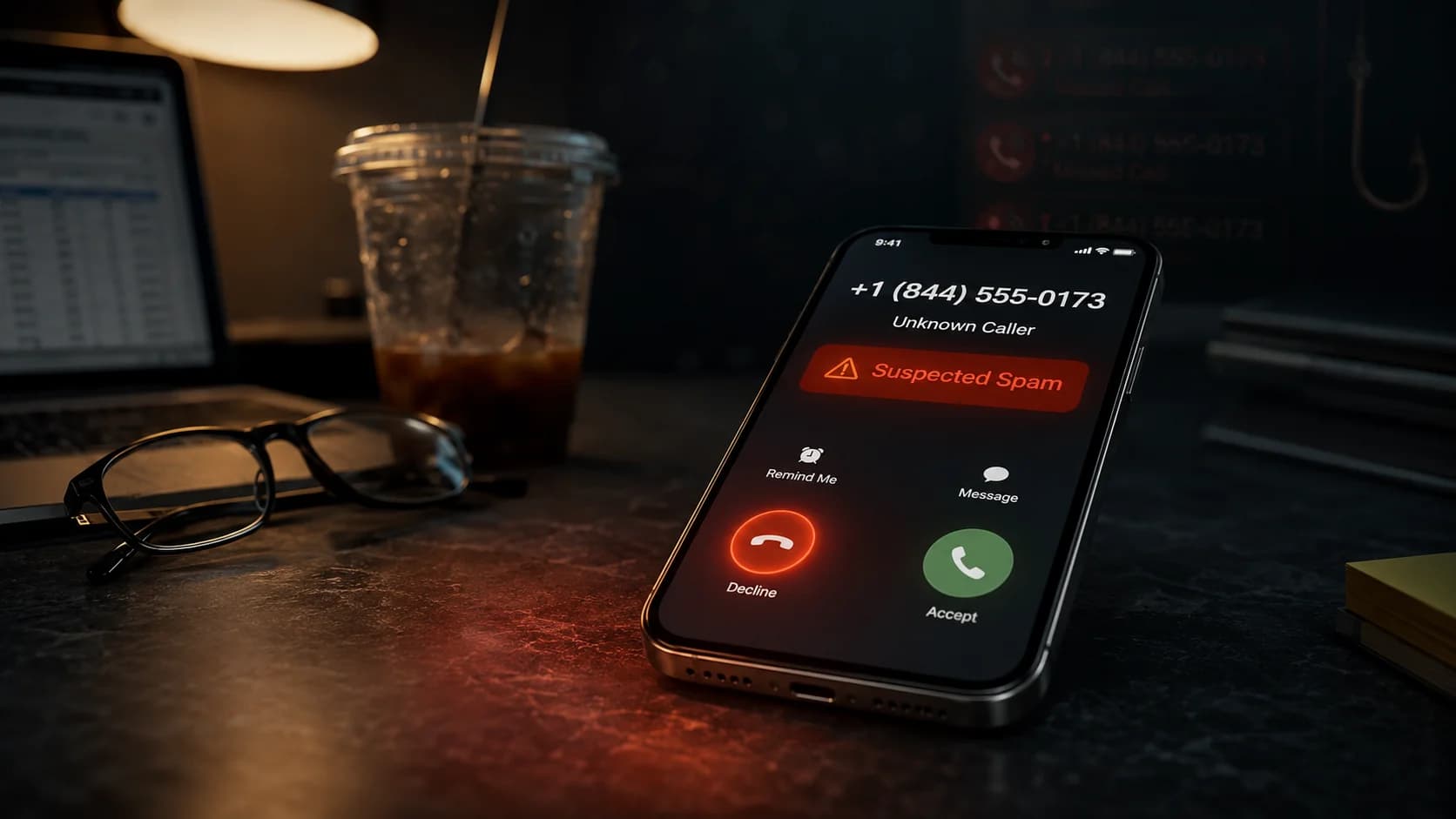
Table of Contents
- Quick answer
- What 844 actually means
- Why scammers use 844 numbers
- Common 844 scam scenarios
- Fake bank or card fraud alert
- Fake tech support or subscription refund
- Fake debt collection or legal threat
- Fake package, utility, or account verification call
- How to tell if an 844 call is legitimate
- Signs the call may be legitimate
- Signs the call is likely a scam
- What to do if you answered
- What to do if you already paid or shared information
- If you paid by card or bank transfer
- If you paid by gift card, crypto, wire transfer, or payment app
- If you gave login details or a one-time code
- If you installed remote-access software
- How to report and block 844 scam calls
- Where BubblyPhone fits
- Related guides
- FAQ
- Is 844 always a scam?
- Is 844 a real area code?
- Can scammers spoof 844 numbers?
- Should I call back an 844 missed call?
- Are all toll-free prefixes the same company?
- What payment methods are the biggest red flags?
- Final take
If you searched for area code 844 scams, the short answer is this: an 844 number is not automatically a scam, but it is also not a trust signal. 844 is a toll-free prefix, not a geographic area code, and scammers use it because toll-free numbers look familiar, national, and official.
That is why the safest way to handle an 844 call is to judge the behavior of the caller, not the prefix. Real businesses use 844 every day. Scammers also use spoofed or rented toll-free numbers to sound like banks, delivery companies, subscription services, debt collectors, or government offices.
Quick answer
An 844 number can be legitimate or fraudulent.
What 844 tells you:
- it is part of the North American toll-free number system
- it is not tied to one city or state
- it often appears on customer support, sales, claims, and booking lines
What 844 does not tell you:
- the caller is real
- the caller is located where they claim to be
- the matching
800or877version belongs to the same company
According to Somos, 800, 888, 877, 866, 855, 844, and 833 are all toll-free codes, but they are not interchangeable and may belong to different subscribers.
What 844 actually means
People often call 844 an “area code,” but that is not technically what it is. It is a toll-free prefix in the same family as:
800888877866855833
That means 844 does not tell you where the caller is. It only tells you the number belongs to the toll-free system.
If you want the broader numbering context around +1, domestic dialing, and toll-free formats, our US country code guide is the best internal reference.
Why scammers use 844 numbers
Scammers like 844 numbers for the same reason legitimate companies do: they look official.
A toll-free number can sound like:
- a fraud department
- a support desk
- a billing team
- a travel line
- a bank or insurance hotline
The FTC warns that scammers can fake the number or name shown on your phone. In its caller ID spoofing guidance, the agency says do not rely on caller ID to verify who is calling, because it can be very difficult to tell whether the displayed number is real.
This is the main point most ranking pages undersell: the real issue is usually spoofing and impersonation, not the 844 prefix by itself.
Common 844 scam scenarios
Most suspicious 844 calls fall into a few recognizable patterns.
Fake bank or card fraud alert
The caller says there is suspicious activity on your account and asks you to:
- confirm card numbers
- read back a one-time code
- approve a payment reversal
- move money to a “safe” account
Fake tech support or subscription refund
The caller says your device is infected, your email is compromised, or you are owed a refund. Then they push you to:
- install remote-access software
- open your banking app
- buy gift cards
- accept a fake refund and send money back
Fake debt collection or legal threat
The caller says you owe money and threatens legal action, arrest, wage garnishment, or account closure unless you pay immediately.
Fake package, utility, or account verification call
The caller says your delivery failed, your electricity will be cut off, or your account is locked unless you verify information right now.
These scripts change, but the pressure pattern is usually the same.
How to tell if an 844 call is legitimate
Use this checklist before you trust any 844 call.
Signs the call may be legitimate
- you expected the call after contacting the company first
- the same number appears on the company’s official website, statement, or app
- the caller is fine with you hanging up and calling the company back yourself
- the caller does not ask for passwords, one-time codes, or full card details
Signs the call is likely a scam
- the caller pressures you to act immediately
- the caller says not to hang up
- the caller wants payment by gift card, cryptocurrency, wire transfer, or payment app
- the caller asks you to read back a login code or approve a suspicious prompt
- the caller gets angry when you say you will verify independently
The FTC’s phone scam guidance is very clear here: if someone insists you can only pay by gift card, crypto, wire transfer, or certain payment apps, it is a scam.
What to do if you answered
If you picked up an 844 call and it feels wrong:
- hang up
- do not confirm personal or financial details
- do not read back one-time passcodes
- do not click links from a follow-up text or email
- do not call back a number from voicemail alone unless you verify it independently
Then look up the company yourself and call the number listed on its official site or app.
If you are unsure how much caller identity really protects you, our anonymous calls guide is a useful companion read because it explains where caller ID assumptions break down.
What to do if you already paid or shared information
This is where most competing 844 articles are too thin. The right next step depends on what you gave the caller.
If you paid by card or bank transfer
Contact your bank or card issuer immediately. Tell them the payment was fraudulent and ask them to block, reverse, or dispute the charge.
If you paid by gift card, crypto, wire transfer, or payment app
Report it to the provider right away. The FTC notes that scammers prefer payment methods that are harder to reverse, which is why speed matters.
If you gave login details or a one-time code
Change the password immediately, sign out of other sessions if possible, and enable stronger authentication.
If you installed remote-access software
Disconnect the device from the internet, uninstall the software, run a security scan, and change important passwords from a different device if you can.
How to report and block 844 scam calls
If the call was suspicious or illegal, report it.
- Report scams and fraud losses to the FTC.
- Report unwanted calls or spoofing to the FCC complaint center. The FCC says to choose
unwanted calls/textsand then the matching sub-issue, includingmy own number is being spoofedif that is what happened. - Block the number on your phone, but remember that blocking one number does not stop a spoofing campaign.
Where BubblyPhone fits
BubblyPhone does not verify whether an incoming 844 caller is genuine, so it is not a scam-detection tool. The safe move is still to verify the company independently.
Where BubblyPhone does help is when you need to call a verified US customer-support number from abroad or without using a normal carrier plan. Toll-free numbers are not always truly free for international callers, and roaming makes those calls even more annoying.
In that situation, BubblyPhone gives you a browser-based way to place the call without committing to another subscription. You top up credit when you need it, your credit does not expire, and you are not paying the same monthly amount during quiet months just to keep an occasional support-calling option around.
If that is your use case, Cheap International Calls, How to Make International Calls, and How to Avoid International Roaming Charges are the best next reads.
Related guides
- US Country Code (+1)
- How to Make Anonymous Calls: *67 and Hide Caller ID
- Virtual Phone Number Guide
- How to Avoid International Roaming Charges
FAQ
Is 844 always a scam?
No. Many legitimate businesses use 844 toll-free numbers. The problem is that scammers also use or spoof them.
Is 844 a real area code?
It is commonly called an area code, but technically it is a toll-free prefix, not a geographic area code.
Can scammers spoof 844 numbers?
Yes. The FTC warns that caller ID can be spoofed, which means the number on your screen may not identify the real caller.
Should I call back an 844 missed call?
Only after you verify the number independently through the company’s official website, app, bill, or statement.
Are all toll-free prefixes the same company?
No. An 844 version and an 800 or 877 version can belong to different subscribers.
What payment methods are the biggest red flags?
Gift cards, cryptocurrency, wire transfers, and urgent payment-app requests are major warning signs according to FTC scam guidance.
Final take
An 844 number is not proof of a scam and not proof of legitimacy.
That is the key idea.
The better question is not “Is 844 bad?” It is “Is this caller behaving like a real company?”
If the caller pressures you, wants unusual payment, asks for codes, or resists independent verification, treat it as a scam. If you need to deal with the company anyway, hang up, find the official number yourself, and start over on your own terms.