Phone Service for Marketing & PR Agencies (2026)
56,053 US PR firms, $32.55B global influencer economy. Cold email response collapsed 8.5%→3-5% (2019→2026); HARO/Connectively shut Dec 2024; AI pitches kill the email channel. Phone is the trust signal again — but personal mobile gets STIR/SHAKEN flagged.
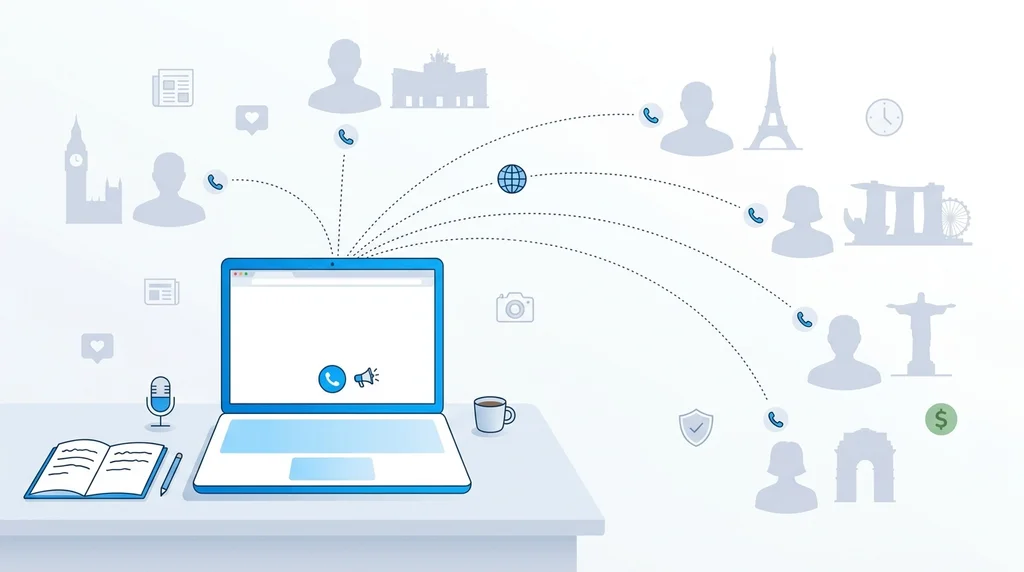
TL;DR — 30-Second Read
- Marketing and PR agency phone service, short answer: solo and boutique agencies should use BubblyPhone (pay-as-you-go, no seats, UK calls from $0.021/min); 5+ person agencies should use Aircall ($30/seat) or RingCentral for CRM sync and call recording.
- Cold email response collapsed from 8.5% to 3-5% (2019→2026); HARO/Connectively shut Dec 9 2024; AI-generated pitches are killing the email channel.
- Skype died 5 May 2025; STIR/SHAKEN now flags personal-mobile cold calls as “Spam Likely” on the journalist's phone.
- BubblyPhone fit for solo / boutique PR: pay-as-you-go, A-attested caller ID, browser-based. UK $0.021, Germany $0.05, Mexico $0.027, Brazil $0.035, India ~$0.10.
- Honest gaps: no Cision / Muck Rack integration, US numbers only, SMS limited to receiving and replying, no call recording. Watch Italy mobile ($0.54) + UAE ($0.39); avoid for ongoing China outreach ($1.47/min).
Cold email response rates have collapsed from 8.5% (2019) to 3-5% entering 2026 — ~half of all inbox spam is now AI-generated (Barracuda, June 2025), and 72% of journalists tell Cision they'd reject pitches that “sound AI-generated.” HARO shut down on 9 December 2024. The phone is the relative trust signal again.
Microsoft retired Skype on 5 May 2025 — the de facto international-calling tool for PR pros chasing London bureaus, Brussels correspondents, and India tech press. This is the honest 2026 guide for solo PR consultants, boutique 2–15 person agencies, and influencer-marketing shops — not for Edelman / Weber / Brunswick.
⚡ Quick Answer
📋 Table of Contents
- The Cold-Email Collapse (8.5% → 3-5%) & Why Phone Is Back
- HARO Shut Down December 2024. Skype Died May 2025.
- STIR/SHAKEN: Why Your Personal Mobile Gets Flagged Spam Likely
- The 56,053 US PR Firms & $32.55B Influencer Economy
- The PR Call Workflow: Journalist Pitch, Influencer Outreach, Crisis
- No PR Tool Includes Outbound International Voice
- 5 Real Phone Options for Solo & Boutique PR in 2026
- International Corridors: UK, Brussels, India, Brazil, Singapore
- Verified Per-Minute Rates & the Cannes-Week Cost Comparison
- What BubblyPhone Is NOT (Honest Gaps for PR)
- FTC Influencer Disclosure, CASL, TCPA & the AI-Voice Ban
- Workflow Tips: Time Zones, Crisis Response, Voicemail Discipline
- Frequently Asked Questions
📉 The Cold-Email Collapse (8.5% → 3-5%) & Why Phone Is Back
The PR profession spent fifteen years optimising for cold-email outreach. That channel is now broken. Verified industry benchmark data:
- 2019: 8.5% average cold-email response rate (Hunter benchmark)
- 2023: 7%
- 2025: 5%
- 2026: 3–5%, depending on industry (Instantly & Mailforge cold-email benchmark reports)
- Barracuda (June 2025): ~half of all inbox spam is now AI-generated
Cision's 2025 State of the Media Report (3,000+ journalists across 19 markets) found:
- Half of journalists receive 50+ pitches per week. 86% will immediately reject anything off-beat.
- 71% are open to PR pros using AI to generate pitches — but 72% are concerned about AI factual accuracy. North American journalists 41% strongly opposed.
- Email is still preferred for first contact (Muck Rack State of Journalism 2025: 62% prefer 1:1 email; 96% report email as primary channel in 2025, up from 87% in 2024).
The implication: email is preferred but degrading; AI-generated pitch volume is hurting the entire channel even for legitimate PR pros writing real pitches. Voice — by definition human-mediated, unscalable, real-time — becomes the relative trust signal for the 2026 workflow. Especially for:
- Relationship-building calls — journalists at Muck Rack's 2025 webinar explicitly named “PR people who ask for a call to discuss what the reporter covers” as preferred behaviour
- Time-sensitive follow-ups on already-pitched stories
- Embargo coordination where email lag is a deal-breaker
- Crisis-PR escalation — voice wins over email decisively here
💀 HARO Shut Down December 2024. Skype Died May 2025.
Two foundational PR-pipeline tools died within five months of each other:
- HARO (Help a Reporter Out) rebranded to Connectively in early 2024, shifted to a pay-to-pitch model, then shut down permanently on 9 December 2024. Cision now focuses on CisionOne. Surviving alternatives: Qwoted, Featured, ProfNet, JustReachOut — none have replicated HARO's scale.
- Skype consumer retired 5 May 2025 (announced 28 February 2025). The de facto international-per-minute calling tool for solo PR pros and boutique agencies for fifteen years. Migration path is Microsoft Teams Free — but Teams is buried inside an enterprise collaboration app, not designed for solo international dial-out.
The combined effect: the low-friction email-first pipeline that fed solo PR consultants for a decade is gone, AND the low-friction international-voice tool is gone. PR pros are now manually outreaching journalists one at a time (more voice, more personalisation, fewer auto-pitches), with phone tools fragmented across BubblyPhone / Quo / Aircall / RingCentral / personal mobile + carrier add-on.
Trade press (PRWeek, PRovoke Media, Adweek, PR News) never published a meaningful migration guide for the Skype consumer shutdown, despite the obvious vertical-specific impact. PR pros worked it out individually.
📵 STIR/SHAKEN: Why Your Personal Mobile Gets Flagged Spam Likely
Since the TRACED Act mandate (deadline 30 June 2021), all major US voice providers implement STIR/SHAKEN caller-ID authentication. Three attestation levels:
- A (full): caller and originating number both verified by the carrier — the gold standard
- B (partial): caller verified but originating number not fully validated
- C (gateway): minimal verification — e.g. inbound from another network
95% of voice traffic among top US Tier-1 carriers now uses A-level attestation. But here's the catch the FCC's February 2025 update made explicit: terminating carriers may use “reasonable analytics” to block or label calls based on traffic patterns even when technically authenticated.
For PR cold-pitch calls from a personal mobile line, the practical effects:
- Calls from personal mobiles are typically B-attested or worse — high “Spam Likely” risk
- A sudden burst of outbound calls to unique journalist numbers from one line triggers volumetric analytics filters
- iPhone “Silence Unknown Callers” and Android “Filter Spam Calls” default-on settings now silently route the call to voicemail
- Voicemails from unknown numbers get deleted unheard at high rates
Mitigation: calls placed from a properly-registered business line with A-attestation (which BubblyPhone provides) avoid the worst of the labeling. But even A-attested business lines can trip volumetric analytics at high cold-pitch call volumes — pace your outreach, don't blast 100 calls in one morning to a journalist list.
📊 The 56,053 US PR Firms & $32.55B Influencer Economy
Verified market data:
- 56,053 US public-relations firms in 2024 (IBISWorld), +3.5% YoY. The long tail of sole-prop LLCs and 2–15 person boutiques is the bulk of this number.
- PR Council: 143 US member agencies; 111 independent + 41 network/holdco offices participated in the 2025 Labor Billing Rate Report. Average billing rate $270/hour 2025 (up from $252 in 2023).
- PRSA: 400+ professional and student chapters across US + Argentina, Colombia, Peru, Puerto Rico.
- PR Boutiques International (PRBI): 25 founder-led member agencies globally as of November 2025 (typically 3–15 employees) — the trade body that exists specifically because solo + boutique founders don't fit the holdco model.
- Influencer-marketing economy: $32.55B in 2025 (Influencer Marketing Hub Benchmark Report 2025), up from $24B in 2024 and $1.4B in 2014. CAGR ~33%.
- Specialised influencer agencies / platforms / tech providers globally: 6,939 (IMH 2025), up from 1,120 in 2019.
- MBO Partners 2025 State of Independence: 5.6M US independent workers earned $100K+ in 2024 (up 19% YoY) — solo PR consultants are a meaningful subset.
The market shape: a few global holdcos at the top (WPP / Edelman / Weber / Brunswick), several hundred mid-tier independents, and tens of thousands of solo consultants and 3–15 person boutiques in the long tail. The per-seat B2B VoIP economics break for everyone except the holdcos.
📞 The PR Call Workflow: Journalist Pitch, Influencer Outreach, Crisis
Common phone-coordination patterns across PR/marketing agency work:
- Journalist relationship-building calls (15–45 min): low-friction intro to a beat reporter, no specific pitch — the “tell me what you cover” conversation Muck Rack 2025 journalists explicitly named as appreciated.
- Pitch follow-up calls (5–15 min): two days after a cold pitch with no response, a single voice follow-up.
- Embargo coordination calls (15–30 min): time-sensitive briefings on news under embargo to selected journalists — email-only is too slow.
- Crisis-PR escalation (15–120 min, often after-hours): 24/7 reachability is contractually table stakes; voice is the only acceptable channel for nuance.
- Influencer contract negotiation calls (30–60 min): after initial DM/email contact through GRIN/Aspire/CreatorIQ, voice enters at contract stage — especially for international creators in different time zones.
- Award-show coordination (Cannes Lions, Effie, SABRE): dense weeks of international voice traffic for submission logistics, jury liaison, on-the-ground meeting scheduling, post-win press.
- International media tour scheduling (45–90 min): coordinating an exec's 4-city European press tour with bureau chiefs in London, Berlin, Paris, Brussels.
- Subsidiary briefing calls with international clients (30–60 min): US agency briefing the Mexico City / São Paulo / Singapore subsidiary on a global campaign.
- Quarterly retainer review calls (45–90 min): predictable, multi-stakeholder, often video-conferenced (Zoom/Teams), but with audio fallback when one party is travelling.
Average annual call volume for a solo PR consultant with ~10–20 active retainer clients: ~400–900 substantive voice calls per year, plus several hundred short follow-up calls. Bursty around award-show weeks, crisis events, and major client launches.
🔧 No PR Tool Includes Outbound International Voice
Verified for the article: none of the major PR media-database and outreach platforms include integrated outbound international voice calling.
- Cision / CisionOne: custom pricing, typically $7K–$25K+/yr. No native outbound voice. Stores journalist phone numbers; doesn't place the call.
- Muck Rack: $5K/year starting; $258–$416/mo for solo billed annually; 1–5 user contracts $10K–$25K/yr. No native voice. Same as Cision — phone is a contact field, not a callable button.
- Meltwater, Notified (formerly Intrado), Critical Mention, NewsWhip, OnePitch, JustReachOut: all media monitoring / outreach — none include voice calling.
- Prowly: $258/mo annual (Basic). Note: Semrush announced December 2025 it was phasing Prowly out effective immediately. No voice integration before that anyway.
- Qwoted: $147–$1,997 monthly tiers. Source-journalist matching, no native voice.
- Influencer tools (GRIN $2.5K–$10K/mo, Aspire $2K+/mo, CreatorIQ $2.5K–$5K+/mo, Upfluence $478–$2K/mo, Klear, Tagger, HypeAuditor, Modash): all manage creator discovery, contracts, payments, DMs/email outreach. None include outbound international voice.
Practical implication: the phone tool is universally bring-your-own-line. PR pros copy the journalist or creator number from their database tab and paste it into BubblyPhone / Aircall / Quo / RingCentral / their personal mobile. The aspirational “click-to-call from Cision” doesn't exist in 2026.
The exception: CRM-side integration. Aircall, OpenPhone/Quo, Dialpad, and RingCentral all integrate natively with HubSpot, Salesforce, and Pipedrive. PR firms that have moved client management into a CRM can get click-to-call from the contact record — that's the core competitive differentiator per-seat VoIP vendors sell to PR. BubblyPhone doesn't do this.
🥇 5 Real Phone Options for Solo & Boutique PR in 2026
BubblyPhone — pay-as-you-go international outbound
Browser-based dialler. Billed per minute. No contract, no seat minimum. STIR/SHAKEN A-attested caller ID. Cheap to most PR-corridor destinations: UK $0.021/min landline + mobile, Germany $0.05, France landline $0.027, Brazil $0.035, Mexico $0.027, India ~$0.10, Hong Kong $0.12. no subscription, no contract.
Honest gaps: no Cision / Muck Rack / HubSpot integration; inbound only on a $3/mo US number (no UK or EU numbers); SMS limited to receiving and replying, so no first-contact texting for influencer outreach; no call recording; no team-shared call logs; Italy mobile $0.54 and China $1.47 are deal-breakers for those corridors. Live rates →
Aircall — HubSpot/Salesforce-integrated PR firms
$30/user/mo annual (or $40 monthly), 3-user minimum — $90/mo floor for a 1-person shop. HubSpot, Salesforce, Zendesk native integrations and click-to-call from CRM. International calling metered separately; only Custom plan (25-license minimum) includes unlimited worldwide. Real total cost runs 50–75% above sticker once add-ons stack.
RingCentral RingEX — established firm choice
$20–$45/user/month (Core, Advanced, Ultra). International calls metered at vendor rates (not publicly listed; rate-sheet request). International numbers add-on $5.99/user/mo per number; toll-free international $14.99/mo + $25 one-time. Right fit for 5+ person firms wanting inbound + SMS + recording + CRM in one stack.
Quo (formerly OpenPhone) — solo + inbound
Rebranded from OpenPhone on 30 September 2025 alongside $96M growth investment from General Catalyst. Pricing: Starter $15/user/mo annual ($19 monthly), Business $23/$33, Scale $35/$47. Unlimited US/Canada on Starter; international metered at vendor rates. Real US business inbound number for journalist callbacks + SMS for influencer DM-style follow-up. Not a heavy-international product.
Personal mobile + carrier international add-on — structurally problematic
Verizon $15/mo International Calling Bundle, T-Mobile Stateside International Talk $15/mo, AT&T World Connect Value $10/mo. Two structural problems for PR: (1) STIR/SHAKEN flags personal-mobile outbound as “Spam Likely” on journalist phones, killing answer rates and voicemail-checking behaviour; (2) personal-number leakage to journalists you may not want calling at all hours forever.
🌍 International Corridors: UK, Brussels, India, Brazil, Singapore
Top corridors for US PR/marketing outreach in 2026:
- UK press: BBC, Guardian, FT, Times, Telegraph, Reuters (London bureau), Bloomberg London, Politico Europe (London office), Sky News, Daily Mail. The primary corridor. 91% of UK journalists prefer pitches under 300 words; 46% prefer 100–200 words. Phone follow-up on a tight pitch works.
- Brussels / EU press corps: Politico Europe HQ; FT, Reuters, AFP, DPA, Euractiv, Semafor, Contexte all expanding. EU institutions accredit hundreds of journalists. 2025 talent movements: Paola Tamma and Barbara Moens (Politico → FT); Javier Espinoza (FT → Capitol Forum).
- India tech press: Economic Times, Inc42 (25M+ tech leaders/mo), YourStory, Mint, Hindu Business Line, TechCrunch India. Norm: track bylines, email direct, follow up in 2–3 days — phone for follow-up.
- LATAM (Mexico, Brazil): the two markets where US-headquartered global brands consistently need PR coverage. BubblyPhone rates very competitive ($0.027 / $0.035 landline).
- Singapore / HK Asia-correspondent network: CNBC, Bloomberg, Nikkei Asia, SCMP (~100K paid daily circ, ~31M monthly readers), Reuters Asia, FT Asia all maintain bureaus.
- Japan / Korea: often accessed via local agency partner relationships. Nikkei Asia is the primary direct-pitch destination for Western PR.
- Influencer-creator corridors: India (growing 40–50% annually), Brazil, Indonesia, Philippines, Russia (89M VK MAU, 74% Telegram penetration, 3% online-ad tax to Russian users since 1 April 2025).
🌐 Verified Per-Minute Rates & the Cannes-Week Cost Comparison
Pulled from bubblyphone.com/rates on 17 May 2026.
| Destination | Landline | Mobile | PR-corridor notes |
|---|---|---|---|
| 🇬🇧 UK | $0.021 | $0.021 | Among the cheapest; primary corridor |
| 🇩🇪 Germany | $0.050 | $0.020 | Mobile is cheaper than landline (unusual) |
| 🇫🇷 France | $0.027 | $0.130 | Mobile expensive — prefer landlines |
| 🇮🇹 Italy | $0.035 | $0.540 | Mobile prohibitively expensive |
| 🇪🇸 Spain | ~$0.070 | ~$0.070 | Both types similar |
| 🇧🇪 Belgium | $0.061 | $0.200 | Brussels press — prefer landlines |
| 🇦🇺 Australia | ~$0.051 | ~$0.16 | Limited APAC corridor for US PR |
| 🇸🇬 Singapore | $0.076 | $0.076 | Asia-correspondent hub |
| 🇯🇵 Japan | $0.061 | $0.061 | Reasonable for Nikkei outreach |
| 🇰🇷 South Korea | $0.054 | $0.054 | Workable |
| 🇭🇰 Hong Kong | $0.120 | $0.120 | Pricier than Japan or Korea |
| 🇲🇽 Mexico | $0.027 | $0.062 | Best LATAM landline |
| 🇧🇷 Brazil | $0.035 | $0.043 | LATAM influencer + global brand PR |
| 🇮🇳 India | $0.091 | ~$0.091 | Tech-press corridor |
| 🇷🇺 Russia | $0.290 | varies | Influencer corridor; sanctions friction |
| 🇮🇩 Indonesia | ~$0.150 | ~$0.150 | Influencer corridor |
| 🇵🇭 Philippines | $0.260 | $0.260 | Expensive |
| 🇦🇪 UAE | $0.390 | $0.390 | Expensive |
| 🇨🇳 China | $1.470 | $1.470 | Don't use for ongoing China outreach |
Cannes Lions week worked example. A solo US PR consultant pitching pre-Cannes coverage to UK, France, Spain, Germany, Italy bureaus. 40 international calls, averaging 6 min each = 240 international minutes, mostly to landlines.
- BubblyPhone: average ~$0.035/min across that mix = ~$8.40 total in calls.
- Aircall Essentials: $30/seat base, 3-user minimum = $90/mo minimum + international metered separately.
- RingCentral Core: $20/mo + international metered (per-minute rates not publicly listed).
- Dialpad Global Unlimited: $20/mo for the add-on (covers EU landlines included) + base Dialpad seat ($15–$25) = $35–$45/mo per user; office-wide rule.
For irregular bursty international PR outreach — which is the actual pattern for solo consultants and boutique shops — BubblyPhone undercuts every per-seat plan by an order of magnitude. The economics flip at ~5–10 person teams with sustained outreach volume and CRM-integrated workflows; for solo and 2–3 person operations, pay-as-you-go is the right shape.
🚫 What BubblyPhone Is NOT (Honest Gaps for PR)
- No Cision / Muck Rack / Meltwater click-to-call. You copy the journalist phone number from your database tab and paste it into BubblyPhone.
- No HubSpot / Salesforce sync. CRM contact-touch logging is manual. Aircall, Quo, Dialpad, RingCentral all do this natively.
- US numbers only. Journalists can call you back on a $3/month BubblyPhone US number (it rings in your browser or app, forwards to your mobile, or takes a transcribed voicemail), but there are no UK or EU local numbers.
- Limited SMS. Your US number receives texts and you can reply, but there is no bulk or first-contact texting, and replies to some carriers can fail. If influencer outreach runs on text, pair with Quo.
- No call recording. For crisis-PR compliance, regulated-industry clients, or internal training, this is a real gap.
- No team-shared call logs. PR-firm collaboration where two consultants share a journalist relationship needs shared call-history visibility — not available.
- No conference calling for client briefings. Quarterly retainer reviews with 5 stakeholders need Zoom / Teams.
- Volumetric Spam-Likely risk persists. Even A-attested business lines can trip carrier analytics if you dial 100 cold-pitch numbers in one morning. Pace your outreach.
- Mobile-rate gotchas: Italy mobile $0.54, Belgium mobile $0.20, UAE $0.39 flat, China $1.47 flat.
- No emergency services. 911 / 999 / 112 don't work via BubblyPhone — use your local mobile.
Where BubblyPhone wins for PR: solo consultants and 2–5 person boutiques with international-heavy outreach, irregular call patterns (heavy during launches and award weeks, light between), and no need for inbound numbers or CRM integration. With no connection fee, a short follow-up call costs one minute at the destination rate.
⚖️ FTC Influencer Disclosure, CASL, TCPA & the AI-Voice Ban
- FTC Endorsement Guides (June 2023 update): “clear and conspicuous” disclosure required; platform “paid partnership” tags alone may not suffice; explicitly covers virtual influencers and ephemeral media. 2025 max civil penalty: $53,088 per violation, adjusted annually for inflation. Each post may be a separate violation. Google + iHeartMedia Pixel 4 settlement: $9.4M. The agency is on the hook, not just the creator.
- FCC AI-voice ban (8 February 2024): AI-generated voice in robocalls banned without prior express consent. Do not use voice cloning or AI agents to place pitch calls to journalists.
- TCPA: $500/violation, up to $1,500 per willful violation. PR cold-pitch calls placed by a human (not auto-dialed) are NOT telemarketing robocalls and are NOT subject to prior express written consent. Auto-dialer behaviour is the trigger to avoid.
- FCC April 2025 consent-revocation rules: consumers can revoke consent by any reasonable means (“STOP,” “UNSUBSCRIBE”). Applies to robocalls/robotexts.
- CASL (Canada): applies to all commercial electronic messages within, from, or to Canada. Penalties up to $1M individual / $10M organisation. B2B carve-out exists for messages to a person engaged in commercial activity with existing relationship — not a blanket exemption.
- GDPR (EU): personal-data processing of journalists, creators, sources triggers GDPR if EU subjects. Lawful basis = legitimate interest typically; document it.
- Lobbying Disclosure Act (federal): 2025 thresholds — $16K quarterly for organisations, $3,500 quarterly per-client for firms. PR firms doing public-affairs work can cross into lobbying territory; register if you meet thresholds and have “lobbying contacts” with covered officials.
💡 Workflow Tips: Time Zones, Crisis Response, Voicemail Discipline
- Always dial in international format (+country code). Drop the leading 0. UK +44 20 ... (drop the 0 from 020 ...).
- For UK / EU journalists: 4–8 AM US ET = 9 AM–1 PM London / Brussels. The peak window for pre-deadline pitch follow-ups.
- For India tech press: 9 PM US ET = 7:30 AM IST — before the work day starts. Don't call after 11 PM IST.
- For Singapore / HK bureaus: 9 PM–midnight US ET = 9 AM–noon SG/HK.
- For Australian bureaus: 5–8 PM US PT = 10 AM–1 PM AU next day.
- For Brazil: direct US-East overlap; the easiest LATAM corridor.
- Pace volumetric outreach. Don't place 100 cold-pitch calls in one morning even from BubblyPhone — volumetric analytics can flag a high-velocity outbound pattern. 10–20 spread across the day is safer.
- Crisis-PR after-hours: top up your BubblyPhone balance to $50–$100 before a launch week or known crisis-prone news cycle. You don't want a zero-balance interruption during a 90-minute crisis call.
- For Cannes Lions / SXSW / CES weeks: the dense international voice traffic mostly happens in 48 hours pre-event. Plan balance accordingly.
- Voicemail discipline: a journalist receiving a Spam-Likely-flagged voicemail from an unknown number will delete it unheard. If you have to leave one, lead with the publication name + a specific story angle in the first 5 seconds — not your name and company.
- Crisis voice-vs-email choice: within the first 30 minutes of a crisis, voice wins. Email leaves a discoverable record agencies often want to avoid in early hours, and decisions need verbal nuance.
- Influencer contract calls: have the FTC disclosure language ready in the conversation — explicit “the post must include #ad / Paid Partnership tag in the format the platform requires” — document the agreement in writing immediately after.
Try BubblyPhone for journalist + influencer outreach
Pay-as-you-go from $5. No contract. UK $0.021/min, Germany $0.05, France landline $0.027, Brazil $0.035, Mexico $0.027, India ~$0.10. STIR/SHAKEN A-attested for better answer rates than personal mobile. Honest about the Italy mobile and UAE flags — full transparency on the rates page. Full rate sheet.
Start Calling❓ Frequently Asked Questions
Is cold-pitching journalists by phone in 2026 actually effective, or annoying?
Why is my personal-mobile cold call showing as “Spam Likely” on the journalist's phone?
Does BubblyPhone integrate with Cision, Muck Rack, or HubSpot?
How much will I spend per month on BubblyPhone as a solo PR consultant?
What about influencer outreach — doesn't that mostly happen via DM?
Should I worry about call recording for crisis-PR conversations?
What replaced Skype for international PR work after May 2025?
Can I use AI voice agents to place pitch calls?
My firm handles public-affairs work for clients. Do we need to register under LDA?
I'm a 5-person PR firm with HubSpot. Should I just use Aircall?
Related Resources
Phone Service for Freelancers
Sister B2B article — same Skype-shaped hole, solo freelancer audience
Phone Service for International Recruiters
Sister B2B article — STIR/SHAKEN spam-flagging context
Phone Service for Expat CPAs
Sister B2B article — regulatory anchor, FBAR coordination
STIR/SHAKEN Explained
How caller-ID authentication affects your outbound answer rates
Skype Shutdown Alternatives
What actually replaces Skype Out for international voice
BubblyPhone Rates
Per-minute rates for every country, pay-as-you-go, no subscription