Phone Service for E-Commerce Sellers Calling International Suppliers (2026)
2025 tariff regime (54% China, 46% Vietnam, 26% India) forces China+1 diversification — cold calling new suppliers is the workflow. WeChat/Zalo/IMO/WhatsApp dominance by country. BubblyPhone Malaysia $0.034, Bangladesh $0.06, India ~$0.09, Vietnam $0.22.
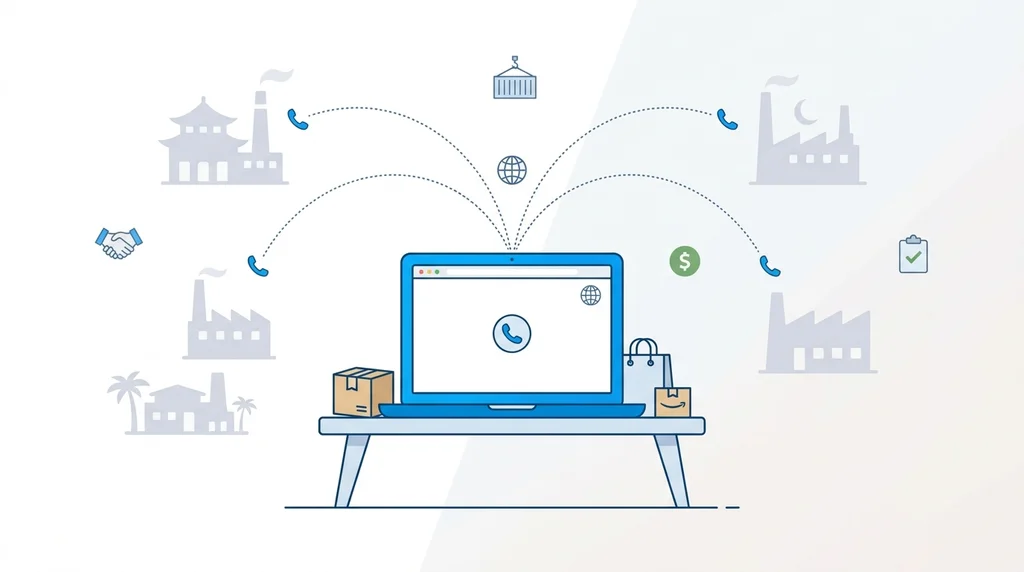
TL;DR — 30-Second Read
- For e-commerce supplier calls, phone new suppliers on a regular number firstfrom a pay-as-you-go dialer with no per-seat fee, then move to their own app: WeChat (China), Zalo (Vietnam), WhatsApp (India), IMO (Bangladesh). The 2025 tariffs (54% China, 46% Vietnam, 26% India) made this China+1 cold-calling the normal sourcing workflow.
- Skype died 5 May 2025 — the tool sellers used to bypass WhatsApp's China block. Landscape is fragmented.
- BubblyPhone fits cold first-contact: Malaysia $0.035, Bangladesh $0.061, India ~$0.10, Vietnam $0.22 landline.
- China at $1.47/min is expensive — use Google Voice or WeChat for ongoing China supplier relationships.
The 2025 tariff regime (54% China, 46% Vietnam, 26% India, 19–37% Bangladesh) pushed e-commerce sellers into aggressive China+1 diversification. That means cold-calling new suppliers in countries where you don't have a WeChat / Zalo / IMO / WhatsApp relationship yet.
Combined with Microsoft's 5 May 2025 Skype shutdown (the tool sellers used for years to bypass WhatsApp's China block), the phone-tool landscape has fragmented. This is the honest 2026 guide for solo Shopify, Amazon FBA, Etsy, and small-importer businesses — not for 500-seat call centres.
⚡ Quick Answer
📋 Table of Contents
- The 2025 Tariff Regime & The “China + 1” Pivot
- The Skype-Shaped Hole That Forced Sellers To Reorganise
- The Dominant-App Patchwork (WeChat / Zalo / IMO / WhatsApp / LINE)
- Why Phone Calls Still Matter for Supplier Communication
- The WeChat Reality for Western Sellers
- The Real Supplier-Calling Workflow (Sample → Production → QC → Re-order)
- 5 Real Options for International Supplier Calling
- B2B VoIP Pricing Compared
- Verified Per-Minute Rates to Top Supplier Countries
- Time Zones (12–13 Hours Ahead for Most Asian Suppliers)
- What BubblyPhone Is NOT (Honest Gaps for E-commerce Sellers)
- Workflow Tips: Cold Contact, QC Crisis Calls, Q4 Peak
- Frequently Asked Questions
📊 The 2025 Tariff Regime & The “China + 1” Pivot
The single biggest change in the e-commerce sourcing landscape between 2023 and 2026 was the US tariff regime. As of 2025, the relevant reciprocal and Section 301 tariffs applied to small-importer-relevant categories include (representative ranges, 2024–2025 actions):
- China: up to ~54% combined Section 301 + reciprocal tariff on many e-commerce categories
- Vietnam: ~46% reciprocal tariff (announced; phased application)
- India: ~26% reciprocal tariff
- Bangladesh: ~19–37% (varied by category; oscillating through 2025)
- Turkey: ~10% reciprocal tariff
- Indonesia: ~32% reciprocal tariff
- Malaysia: ~24% reciprocal tariff
The aggregate effect was a forced “China + 1” (or “China + N”) sourcing diversification. Sellers who had run their entire operation on a couple of established China factory relationships started cold-calling suppliers in Vietnam, India, Bangladesh, Indonesia, Turkey, and Malaysia. Modern Retail, eCommerceBytes, and the AmazonSellerCentral forums all documented the same pattern through 2024– 2026: established sellers diversifying to 2–4 country sources, new sellers starting outside China entirely.
The consequence for the phone-tool problem: you can't rely on existing WeChat relationships with Chinese factories you've worked with for five years. You need to make first-contact cold calls to factory sales reps in countries where the dominant messaging app isn't WhatsApp. That's a different problem than maintaining existing supplier relationships, and it's the problem this article is mostly about.
🕳️ The Skype-Shaped Hole That Forced Sellers To Reorganise
For roughly fifteen years, Skype Credit was the default international-calling tool for e-commerce sellers calling overseas suppliers. The economics fit: pay-as-you-go, per-second billing, decent rates to most supplier markets, browser/desktop apps. Crucially, Skype was one of the only practical voice-call options into China after WhatsApp was blocked behind the Great Firewall in 2017 (Reuters / BBC coverage). For nearly eight years, US-based Etsy / Shopify / Amazon FBA sellers used Skype to make first-contact calls to Shenzhen, Yiwu, and Guangzhou suppliers because WeChat registration was cumbersome and WhatsApp simply didn't work.
Microsoft shut down Skype Credit pay-as-you-go on 1 January 2025, retired consumer Skype on 5 May 2025, and the final calling-subscription wind-down completes 1 May 2026. Microsoft initially refused refunds for unused prepaid credit balances, later reversed under public pressure (Washington Post, May 2025). The positioned successor is Teams “Skype Dial Pad,” which requires either a Microsoft 365 subscription or a Teams Phone Standard licence ($8/user/month plus base Teams) — and the UX is designed for enterprise collaboration, not solo seller cold-calling.
E-commerce trade press (Modern Retail, eCommerce Bytes, Practical Ecommerce, Shopify blog, AmazonSellerCentral knowledge base) never published a meaningful migration guide for the supplier-calling use case. Reddit's r/FulfillmentByAmazon, r/Entrepreneur, r/dropship, and r/ecommerce subreddits have scattered threads since May 2025, but no consensus tool. The fragmentation is real: sellers are spread across Google Voice Workspace, WeChat International, Twilio (for the technical), per-seat B2B VoIP, and personal-mobile-with-carrier-international-add-on.
💬 The Dominant-App Patchwork (WeChat / Zalo / IMO / WhatsApp / LINE)
The single most important fact about supplier communication in 2026 is that there is no single dominant messaging app across the major sourcing countries. Each supplier country has its own primary app:
| Country | Dominant app | WhatsApp status | User reach |
|---|---|---|---|
| 🇨🇳 China | Blocked since 2017 | ~1.36B MAU WeChat | |
| 🇻🇳 Vietnam | Zalo | Some use, not dominant | ~79M Zalo MAU vs ~6% WhatsApp penetration |
| 🇧🇩 Bangladesh | IMO | Present, not dominant for vendor comm | 35.8B international calls on IMO in 2023 |
| 🇮🇳 India | Dominant, works well | ~500M+ WhatsApp users | |
| 🇵🇰 Pakistan | Dominant | ~60M+ WhatsApp users | |
| 🇮🇩 Indonesia | WhatsApp + LINE | WhatsApp dominant | ~110M+ WhatsApp users |
| 🇹🇷 Turkey | WhatsApp + Telegram | WhatsApp dominant | ~50M+ WhatsApp users |
| 🇪🇬 Egypt | VOICE THROTTLED by carriers since 2017 | ~56M WhatsApp users; voice calls degraded | |
| 🇹🇭 Thailand | LINE | Present, secondary to LINE | ~52M LINE users (highest LINE penetration globally outside Japan) |
| 🇲🇾 Malaysia | Dominant | ~30M+ users | |
| 🇰🇷 South Korea | KakaoTalk | Niche, <10% penetration | ~48M Kakao MAU |
| 🇯🇵 Japan | LINE | Niche, <5% penetration | ~96M LINE MAU |
Practical consequence: if you're a US-based seller cold-calling a Vietnamese sandalwood factory, your WhatsApp is irrelevant because they use Zalo. Your Zalo requires Vietnamese-mobile registration to function smoothly. The phone number on the factory's Alibaba listing is the only universal channel you can actually reach them on for first contact. Same applies for IMO-only Bangladesh suppliers, KakaoTalk-only Korean OEMs, LINE-only Thai factories.
📞 Why Phone Calls Still Matter for Supplier Communication
Five concrete situations where phone calls beat the messaging-app patchwork:
- First contact with a new supplier. You don't have WeChat / Zalo / IMO with them yet. The phone number on their listing is your only voice channel.
- Escalation when text isn't getting through. Quality control crisis, missed deadline, defective batch — sales reps respond faster to a phone call than to a fifth WhatsApp message.
- Language-barrier verification. Voice removes ambiguity that text translation introduces. Critical for OEM spec discussions where mistaken text could result in 10,000 wrong-coloured units.
- Discount negotiation. Factory sales reps have authority to discount on the phone that they often won't put in writing. Chinese and Indian business cultures both place high value on voice contact for pricing conversations.
- Q4 peak-season crisis management. September–November for Black-Friday/Christmas-bound sellers is brutal — production delays, shipping container shortages, customs issues all surface, all need real-time voice resolution.
Plus the structural fact that WhatsApp voice is throttled or blocked in several major supplier markets: blocked in China (Great Firewall, since 2017), throttled in Egypt by every major carrier (Vodafone, Orange, etisalat by e&, WE since 2017 — NTRA announced a lift in late 2024 but practical implementation remained patchy through 2026), and blocked in UAE / Qatar / Iran on every consumer network (less relevant for supplier calling but worth knowing if you source from those markets).
🟢 The WeChat Reality for Western Sellers
WeChat is required for almost all established China-supplier communication. WeChat has ~1.36 billion monthly active users and roughly 99% penetration among Chinese internet users. When it works, WeChat voice calls to Chinese factory sales reps are free and high-quality.
The problem for Western sellers in 2024–2026 is WeChat registration friction. Since 2017–2018, WeChat has tightened account-creation rules for non-Chinese phone numbers. New accounts created from foreign numbers often hit the “Help Friend Register” wall — WeChat requires an existing verified WeChat user (typically a Chinese national) to scan a QR code and confirm your account before activation. Without a Chinese contact willing to help, many Western sellers cannot create a working WeChat account at all.
Even with a working WeChat account, certain features (WeChat Pay, Mini Programs, public account interactions) are tied to Chinese ID verification. For supplier-calling specifically, voice calls work fine once you're on each other's WeChat contact list. The catch is getting there from a cold start. Most factories list a phone number on their Alibaba.com / Made-in-China.com / 1688overseas listing — that's your initial entry point. Once you've made first contact by phone and exchanged WeChat IDs, ongoing communication usually shifts to WeChat for cost reasons.
Practical implication: for ongoing daily WeChat-replacement, BubblyPhone is not the cheapest tool (China rate is $1.47/min flat — substantially more expensive than Google Voice ~$0.02/min or Twilio ~$0.06/min). For the specific problem of first-contact phone calls to a new Chinese factory before you have WeChat with them, BubblyPhone's browser-only no-setup convenience can be worth the rate premium for the 1–3 initial calls. After that, switch to WeChat for ongoing comms.
🔄 The Real Supplier-Calling Workflow
- Initial sourcing call (5–15 min): Verify factory legitimacy, MOQ, capability for your specs.
- Sample request & follow-up (5–10 min): Coordinate sample shipment, payment method.
- Sample quality discussion (10–20 min): Review received sample, request modifications.
- OEM / custom-modification negotiation (20–45 min): Specs, materials, packaging, branding. The longest calls in the workflow.
- Pre-production prototype approval (10–20 min): Photos / video review, sign-off.
- Production timeline confirmation (5–10 min): Lead time, shipping window.
- Quality control coordination (10–30 min): Either with the factory or a third-party inspection company (QIMA, AsiaInspection, etc.).
- Shipping logistics (10–20 min): Freight forwarder, Amazon Partnered Carrier, customs broker.
- Issue escalation (15–45 min): Defective batch, delayed shipment, customs clearance issues, payment disputes.
- Re-order coordination (5–15 min): Repeat business, adjusted specs, MOQ changes.
A typical small Amazon FBA private-label brand working with one factory in one country might make 8–15 calls per product launch (sample-to-first-shipment), then 2–4 calls per re-order. A multi-product brand with 4–5 active suppliers across China, Vietnam, India, and Bangladesh might run 30–80 international supplier calls per month — mostly short, with occasional crisis spikes.
🥇 5 Real Options for International Supplier Calling
BubblyPhone — pay-as-you-go (non-China sweet spot)
Browser-based outbound dialler. No monthly commitment. No seat minimum. Verified rates: Malaysia $0.05/min, Bangladesh $0.061/min, South Korea $0.057/min, India $0.091/min, Turkey landline $0.12/min, Indonesia $0.15/min, Vietnam landline $0.22/min — all genuinely cheaper than per-seat-monthly B2B alternatives. China at $1.47/min flat is the exception — use sparingly for first-contact only.
Honest gaps: US numbers only (no local numbers in supplier countries), no SMS outreach, no team logs, no CRM integration. Live rates →
WeChat (China only) — the only ongoing China answer
For ongoing daily communication with established Chinese suppliers, WeChat is the answer — free, high-quality, and what your suppliers already use. Getting past the registration friction is the main hurdle. Some sellers find a Chinese assistant or fellow seller to verify their account; others use a Hong Kong / Taiwan / Singapore number for registration.
Google Voice for Workspace — cheap China outbound
For high-volume China calling specifically, Google Voice Premier ($30/user + $7 Workspace = $37/user/month) plus per-minute China rates around $0.02/min is structurally cheaper than BubblyPhone's $1.47/min. Trade-off: monthly commitment, Workspace required, no inbound non-US numbers.
Full B2B VoIP (RingCentral, Aircall, Zoom Phone, Dialpad)
For 3+ person teams with shared inbound, customer-service phone numbers, CRM integrations. Overspec'd for solo sellers. Aircall has a 3-seat minimum = $90/month floor. Dialpad Pro requires Global Unlimited add-on across all seats.
Twilio Voice — cheapest per-minute, requires setup
Lowest raw per-minute rates anywhere (China ~$1.47/min, India ~$1.47/min). No monthly commitment. But Twilio is a developer platform — you need to set up a SIP softphone, configure trunking, and manage routing yourself. Realistic only if you have technical staff or can spend a weekend on setup.
💵 B2B VoIP Pricing Compared
| Provider | Entry price | Seat minimum | International coverage | Contract |
|---|---|---|---|---|
| BubblyPhone | $0/mo | 1 | Per-minute (cheap to most Asia; expensive to China) | None (PAYG) |
| Google Voice Premier + Workspace | $37/user/mo | 1 | ~20 country bundle; per-min extra; ~$1.47/min China | Monthly or annual |
| RingCentral RingEX Core | $20–$30/user/mo | 1 | Per-min extra OR $20+ add-on | Annual or monthly |
| Aircall Essentials | $30/user/mo annual | 3 | Per-minute extra | Annual |
| Zoom Phone Pro Global Select | $20/user/mo | 1 | ~19 countries unlimited | Monthly or annual |
| Dialpad Pro | $25/user/mo + Global Unlimited | 3 | Global add-on mandatory across all seats | Annual |
| Microsoft Teams Phone w/ Intl | ~$34/user/mo + Teams sub | 1 | 3,000 dom + 600 intl minutes pool | Annual |
| Twilio Voice | $0/mo (usage-based) | N/A | ~$0.013–$0.06/min Asia (cheapest) | None (PAYG) |
🌏 Verified Per-Minute Rates to Top Supplier Countries
Pulled from bubblyphone.com/rates on 17 May 2026. Most factory sales-rep desks are reached on landline numbers (mobile rates sometimes higher).
| Supplier country | Landline | Common sourcing categories |
|---|---|---|
| 🇲🇾 Malaysia | $0.035 | Electronics, rubber/latex products, palm-oil-based goods, packaging |
| 🇧🇩 Bangladesh | $0.061 | Ready-made garments (RMG), textile, leather goods, jute products |
| 🇰🇷 South Korea | $0.057 | Cosmetics OEM (K-beauty), electronics components, automotive parts |
| 🇮🇳 India | $0.091 | Textiles, leather, jewellery, handicrafts, ayurveda/wellness, IT services |
| 🇹🇷 Turkey (landline) | $0.12 | Textile, leather, ceramics, hazelnuts, marble; Istanbul / Bursa hubs |
| 🇵🇭 Philippines | $0.26 | BPO services, electronics assembly, coconut/agricultural products |
| 🇮🇩 Indonesia | $0.15 | Rattan, bamboo, batik textiles, palm-oil products, furniture; Bali / Jakarta / Yogyakarta hubs |
| 🇹🇭 Thailand | $0.20 | Silk, rubber, automotive parts, electronics; Bangkok hub |
| 🇻🇳 Vietnam (landline) | $0.22 | Textile, footwear, electronics, furniture, bamboo; Ho Chi Minh / Hanoi / Hai Phong |
| 🇪🇬 Egypt (Cairo) | $0.71 | Textiles, leather, ceramics, handicrafts |
| 🇵🇰 Pakistan | $0.091 (mobile-equivalent baseline) | Textile (cotton), leather, sporting goods (Sialkot), surgical instruments |
| 🇨🇳 China (mainland, all cities) | $1.47 (flat) | All categories (Shenzhen, Yiwu, Guangzhou, Shanghai). BubblyPhone's most expensive destination — use sparingly. |
The honest China rate caveat: BubblyPhone's $1.47/min flat to China reflects current wholesale termination pricing for the China corridor. Google Voice (~$0.02/min) and Twilio (~$0.06/min) are dramatically cheaper for ongoing China calling. Use BubblyPhone for China only for short first-contact calls before you have WeChat with the supplier; for established daily communication, WeChat or Google Voice are better economic choices.
For the China + 1 destinations (Vietnam, India, Bangladesh, Indonesia, Malaysia, Turkey, Philippines, Thailand — the suppliers most sellers are pivoting to in 2026), BubblyPhone's per-minute rates are meaningfully cheaper than per-seat-monthly B2B VoIP alternatives at the call volumes typical for small/mid-market e-commerce sellers.
🕒 Time Zones (Most Asian Suppliers Are 11–13 Hours Ahead)
Time-zone math is one of the biggest practical pain points for US-based sellers calling Asian suppliers:
- China: +12 hours from US ET (winter), +11 hours (summer). Best window: 8–11 PM US ET = 8–11 AM next day China. Or 6–9 AM US ET = 6–9 PM same day China.
- India: +10.5 hours from US ET (winter), +9.5 (summer). Best: 8–11 PM US ET = 6:30–9:30 AM next day India.
- Vietnam: +11–12 hours. Similar to China; 9 PM–midnight US ET = morning Vietnam.
- Bangladesh: +10–11 hours. 8–11 PM US ET = 6–9 AM Dhaka.
- Pakistan: +9–10 hours.
- Indonesia: +11–13 hours (Jakarta is UTC+7, Bali UTC+8). Jakarta: 8–11 PM US ET = morning Jakarta.
- Thailand: +11–12 hours.
- Malaysia: +12–13 hours.
- Philippines: +12–13 hours.
- South Korea / Japan: +13–14 hours.
- Turkey: +7–8 hours. Easier window: morning US Eastern = afternoon Turkey.
- Egypt: +6–7 hours. Morning US Eastern = afternoon Egypt (Egypt observes DST since 2023).
Practical rule: for most Asian suppliers, the “late evening US” window (8–11 PM ET) catches them at morning start-of-business the next day. The “early morning US” window (5–8 AM ET) catches them at end-of-workday. Avoid 12–6 PM US time for Asian calls — that's the middle of the night for them.
🚫 What BubblyPhone Is NOT (Honest Gaps for E-commerce Sellers)
- US numbers only. A BubblyPhone US number ($3/month) lets suppliers call you back: it rings in your browser or app, forwards to your mobile, or goes to voicemail with a transcript. There are no local numbers in China, Vietnam or other supplier countries.
- No SMS outreach. A BubblyPhone US number receives texts and you can reply, though replies to some carriers can fail; it is not a tool for texting suppliers first. Pair with WhatsApp / Zalo / IMO depending on supplier country.
- No Shopify, Amazon Seller Central, or Etsy integration. No click-to-call from your e-commerce platform. You dial in BubblyPhone's browser; you log notes in your sourcing spreadsheet or PM tool separately.
- No call recording. If you need to document supplier calls for legal or compliance reasons, use a separate recording app — and verify two-party-consent state laws.
- No team-shared call logs. If you have an assistant or VA doing supplier calls, each account is separate.
- No emergency services. 911 / 999 / 000 / 112 don't work via BubblyPhone — use your local mobile.
- Not the cheapest for China. Already covered above — $1.47/min flat. Use WeChat or Google Voice for high-volume China calling.
💡 Workflow Tips: Cold Contact, QC Crisis Calls, Q4 Peak
- Always dial in international format (+country code). Chinese factory 0755 ... becomes +86 755 ... Drop the leading 0. Most common failure mode is keeping the domestic trunk prefix.
- For first-contact China factories: the Alibaba.com / Made-in-China.com listing usually shows a phone number. Call that to introduce yourself, exchange WeChat IDs, then shift ongoing comms to WeChat. BubblyPhone's convenience is worth the $1.47/min for the 5–10 minute initial call.
- For Vietnam, India, Bangladesh, Malaysia suppliers: BubblyPhone is genuinely competitive per-minute. Use it freely; you don't need to ration calls.
- For Q4 peak season (Sept–Nov for Black Friday / Christmas inventory): top up your BubblyPhone balance to $50–$100 before peak so you don't hit zero balance during a 30-minute Vietnam supplier crisis call.
- For language-barrier calls: have your spec sheet / sample photos / PO document open in another browser tab. Reference exact part numbers and specifications rather than relying on translated descriptions.
- For QC crisis calls, escalate by phone the moment a written message doesn't get a same-day response. A 20-minute factory call resolves issues that 5 unanswered WhatsApps don't.
- For Egypt suppliers: WhatsApp voice is unreliable due to carrier throttling since 2017 — default to direct-dial PSTN via BubblyPhone for actual voice calls. Egyptian factories typically have established landlines.
- For Turkish suppliers: landline rates ($0.17/min) are reasonable. Mobile rates ($0.77+/min) are not — favour landline numbers when listed.
- Save numbers in international format from day one. +86 755 ..., +84 28 ..., +880 17 ..., +91 22 ..., +90 212 ... — works from any device.
Try BubblyPhone for supplier calls
Pay-as-you-go from $5. No monthly commitment. Malaysia $0.06/min, Bangladesh $0.061/min, India ~$0.10/min, Turkey $0.10/min landline. Honest about the China rate — we link straight to the live rates page. Full rate sheet.
Start Calling❓ Frequently Asked Questions
What replaced Skype for e-commerce sellers calling China after 5 May 2025?
Why is BubblyPhone's China rate so high compared to other VoIP services?
Can I get WeChat without a Chinese phone number?
How do I dial a Chinese factory number from the USA?
Which Asian supplier countries are cheapest to call on BubblyPhone?
When is the best time to call Chinese suppliers from the US?
My Vietnamese supplier doesn't have WhatsApp. What do I use?
Does BubblyPhone integrate with Shopify, Amazon Seller Central, or Alibaba TradeManager?
What if my supplier's phone number doesn't work or rings out?
How much will I spend per month on BubblyPhone as an e-commerce seller?
Related Resources
Phone Service for Travel Agencies
Sister B2B article — same Skype-shaped hole, travel-agent audience
Phone Service for Destination Wedding Planners
Sister B2B article — solo-planner economics
Call China from USA
Country-specific guide with dialing format + WeChat context
Call Vietnam from USA
Zalo dominance + supplier-calling context for Vietnam
Call Bangladesh from USA
IMO dominance + post-2024 RMG-industry context
Call India from USA
India supplier corridor for textile / leather / handicrafts
BubblyPhone Rates
Per-minute rates for every country, pay-as-you-go, no subscription
Call Egypt from USA
WhatsApp-voice throttling context for Egyptian suppliers
Start Calling
Sign up, top up from $5, start dialing in under 60 seconds