Wholesale Voice Provider: Your 2026 Guide to VoIP & SIP

Table of Contents
- What Is a Wholesale Voice Provider
- The invisible layer behind many calls
- Why businesses use one
- Why this matters to non-carriers
- How Wholesale Voice Systems Work
- The basic call journey
- Where VoIP, SIP, and WebRTC fit
- VoIP is the broad concept
- SIP is the signaling method
- WebRTC is the browser-friendly layer
- Why routing matters
- Decoding Wholesale Pricing and Termination Models
- The three moving parts in price
- Why route type changes the bill
- Transparency is the real differentiator
- Essential Metrics for Voice Quality and Reliability
- The metrics that actually matter
- MOS
- Latency
- Jitter
- Packet loss
- What strong providers target
- How to read these numbers like a buyer
- Questions worth asking in plain English
- Integrating and Implementing a Wholesale Voice Service
- Two common integration paths
- API-driven integration
- Webhook-driven integration
- Migrating from a traditional phone setup
- What smaller teams often overlook
- A Buyer's Checklist for Choosing Your Provider
- The practical checklist
- Match the provider to the operator
- Questions that expose weak vendors
- The BubblyPhone Advantage for Modern Voice Needs
- Where the market still falls short
- Why an API-first model changes the experience
- Who benefits most
You might be looking at calling options right now because something has stopped fitting. Your team started with a simple VoIP app, then needed outbound sales calls in multiple countries. Or you built an AI voice prototype and discovered that placing real phone calls is much harder than streaming audio in a browser. Or you're a small business owner trying to understand why one provider talks about SIP trunks, another talks about termination, and a third wants a contract before showing rates.
That confusion is normal. Wholesale voice sits underneath many calling products people use every day, but most explanations are written for telecom carriers, not for developers, startups, or smaller companies. The good news is that the core ideas are simpler than they sound once you strip away the jargon.
What Is a Wholesale Voice Provider
A wholesale voice provider is a company that carries phone calls between networks at scale. Instead of selling a simple calling plan to one person, it supplies the infrastructure that other businesses use to originate, route, and terminate calls across cities, countries, and carrier networks.
Consider freight shipping. Most companies don't build their own cargo fleet just to move products around the world. They rely on logistics networks that already connect ports, warehouses, and final delivery systems. Wholesale voice works the same way for phone calls.
The invisible layer behind many calls
When someone places an international call, that call often doesn't travel entirely on the retail provider's own network. A wholesale provider may handle the long-distance transport, the carrier interconnect, or the handoff into the destination country.
That role is bigger than many people realize. The global wholesale voice carrier market is projected at approximately USD 44.53 billion in 2026 and projected to reach USD 73.63 billion by 2031, with a 10.58% CAGR, according to Mordor Intelligence's wholesale voice carrier market analysis. That scale tells you something important. This isn't a niche technical service. It's core telecom infrastructure.
Why businesses use one
A business turns to a wholesale voice provider when it needs one or more of these:
- Broader reach: Calling customers, vendors, or family contacts in many countries without negotiating local telecom relationships one by one.
- Better economics: Accessing lower underlying rates than typical retail calling products.
- Scalability: Handling anything from a handful of calls to large bursts of traffic.
- Programmable voice: Letting software trigger, receive, or manage calls through APIs.
Practical rule: If your calling needs involve multiple countries, custom workflows, or application-based calling, you're already close to wholesale voice territory whether you use that term or not.
Why this matters to non-carriers
Older telecom content treats wholesale voice as a carrier-only subject. That's outdated. Today, the same infrastructure can support a remote sales team, a browser-based support desk, or an AI voice application that needs to call real phone numbers.
For a small company, value isn't owning telecom infrastructure. It's getting access to it without becoming a telecom operator.
How Wholesale Voice Systems Work
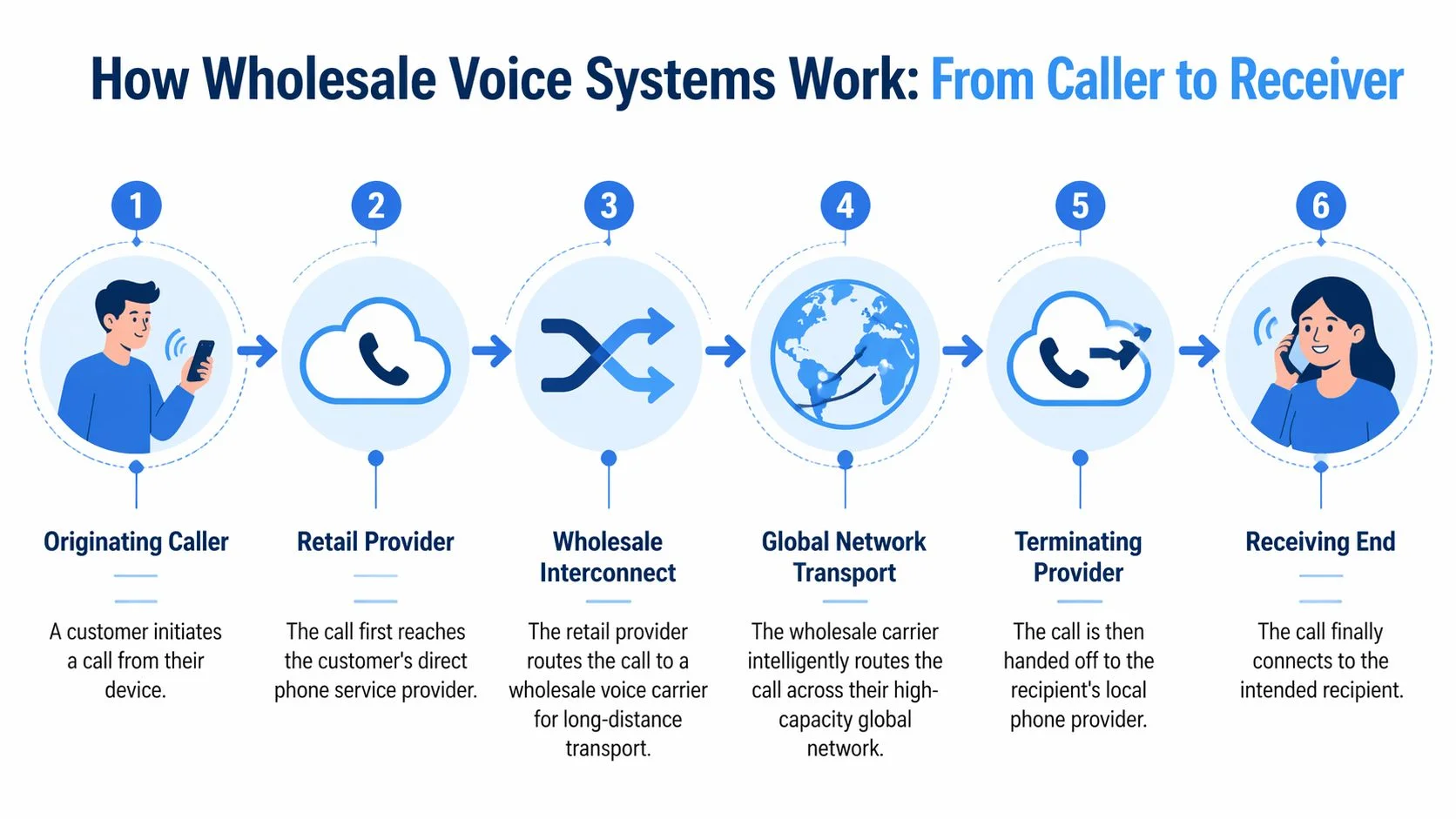
A call path becomes easier to understand if you picture a global shipping network. A package starts with the sender, moves through local pickup, enters a long-haul network, gets handed to a local delivery partner, and arrives at the recipient. Voice calls follow a similar chain.

The basic call journey
A simple version looks like this:
- A caller starts a call from a browser, softphone, mobile app, desk phone, or PBX.
- The retail or application provider receives the request and decides where the call needs to go.
- A wholesale interconnect carries the call across larger networks and selects a path toward the destination.
- A terminating provider hands it off locally so the receiving phone can ring.
If you strip out the acronyms, the job is straightforward. One network gets the call started. Another helps move it efficiently. Another finishes delivery.
Where VoIP, SIP, and WebRTC fit
These three terms often get mixed together, but they do different jobs.
VoIP is the broad concept
VoIP means voice over internet protocol. It means the call travels as internet data rather than staying on old circuit-switched lines for the whole trip.
If you call from a laptop or browser, you're using a VoIP-style approach even if you never see the term.
SIP is the signaling method
SIP is often the system that sets up, manages, and ends voice sessions. If VoIP is the idea of sending voice over IP, SIP is one of the main ways systems coordinate the call.
For businesses, SIP trunking matters because it replaces fixed physical phone circuits with virtual capacity. According to Twiching's explanation of wholesale voice and SIP trunking, SIP trunking can scale from 1 to 10,000+ channels per trunk without hardware installs and can cut infrastructure costs by 60-80%. That's why companies like it. You don't need a telecom closet upgrade just because your call volume changed.
WebRTC is the browser-friendly layer
WebRTC makes real-time voice possible in web browsers and apps. It's what allows a user to click and call without downloading a traditional desktop softphone.
For a startup, that changes the user experience completely. Instead of shipping hardware or configuring desk phones, the team can often work from a browser.
The easiest way to remember it is this. VoIP is the category, SIP helps control the call, and WebRTC helps modern apps and browsers participate.
Why routing matters
Not every path between two phones is equal. A wholesale voice provider has to choose how a call travels. That decision affects cost, delay, and clarity.
Good routing avoids unnecessary hops. Too many handoffs can hurt the experience, especially on international calls where timing already matters. If you've ever heard someone say "hello" and then wait through an awkward pause, you've heard routing quality in action.
Decoding Wholesale Pricing and Termination Models
Pricing is where many buyers get lost, partly because providers often describe rates in carrier language. The cleaner way to think about it is to separate what you're paying for, how the call is delivered, and how transparent the provider is willing to be.
The three moving parts in price
Most wholesale voice pricing comes down to a few components:
- Per-minute usage: You pay based on call duration, usually by destination.
- Termination cost: The price of delivering the call into the destination network.
- Provider margin and platform costs: What the provider adds for access, tooling, support, or convenience.
Some businesses prefer a simple pay-as-you-go model. Others take volume commitments in exchange for lower rates. Neither is automatically better. It depends on how predictable your usage is.
Why route type changes the bill
A cheap route isn't always a good route. In wholesale voice, buyers often hear about white routes and grey routes.
A small team usually benefits from asking a simple question first: "Can I understand the route quality before I understand the discount?"
Transparency is the real differentiator
One of the biggest gaps in this market isn't technology. It's usability. As noted in Twiching's review of wholesale VoIP providers, OTT price erosion has created pressure on wholesale margins, but it has also exposed the need for transparent per-minute pricing for non-carriers like migrants and SMBs who often don't get clear rate sheets for international calling to 100+ countries.
That matters because a non-carrier buyer doesn't think like a wholesaler. They want answers to practical questions:
- What will this destination cost me?
- Are there hidden setup or maintenance fees?
- Is caller ID preserved?
- Will the quality be good enough for customer calls?
If you want a good benchmark for what transparent destination pricing can look like, compare providers against a public international calling rates page rather than relying on a sales PDF alone.
Cheap-looking rates without route details often create expensive problems later.
Essential Metrics for Voice Quality and Reliability
If pricing tells you what a call costs, quality metrics tell you what the conversation feels like. At this juncture, telecom terms start to sound intimidating, but most of them map directly to everyday experience.


The metrics that actually matter
When evaluating a wholesale voice provider, focus on four practical indicators.
MOS
MOS, or Mean Opinion Score, is a shorthand measure of voice quality. Higher is better. It reflects whether people perceive a call as clear and natural.
Latency
Latency is delay. If it's high, people talk over each other because the audio arrives late.
Jitter
Jitter is variation in packet timing. Even if a connection is fast overall, uneven delivery can make speech sound choppy.
Packet loss
Packet loss means some audio data never arrives. Missing packets can turn words into fragments.
What strong providers target
According to VideoSDK's wholesale VoIP guide, wholesale voice providers use least-cost routing algorithms that can reduce per-minute costs by 30-50% while still targeting latency below 150ms, packet loss below 0.1%, and MOS scores above 4.2 for HD voice.
That detail is worth slowing down on. Least-cost routing, or LCR, doesn't just mean "pick the cheapest path." A capable provider weighs quality and cost together. Done well, it acts like a traffic-aware navigation app for voice calls.
How to read these numbers like a buyer
You don't need to become a network engineer. You just need to ask better questions.
- If MOS is strong: conversations should sound more natural.
- If latency is low: back-and-forth dialogue feels immediate.
- If packet loss is controlled: words don't disappear mid-sentence.
- If routing is managed actively: quality should remain more stable as destinations and traffic patterns change.
A simple way to sanity-check your own environment is to run a VoIP speed test tool before blaming the carrier. Sometimes the problem isn't the provider at all. It's office Wi-Fi, a crowded home network, or a browser tab consuming resources.
A provider can own the network path. You still own your local connection quality.
Questions worth asking in plain English
When you speak with a provider, skip vague questions like "Is your quality good?" Ask these instead:
- What metrics do you monitor continuously?
- How do you handle route changes when quality drops?
- What destinations are direct versus indirect?
- How do you separate low-cost routing from risky routing?
Those questions usually reveal whether the provider has real operational depth or just a low rate card.
Integrating and Implementing a Wholesale Voice Service
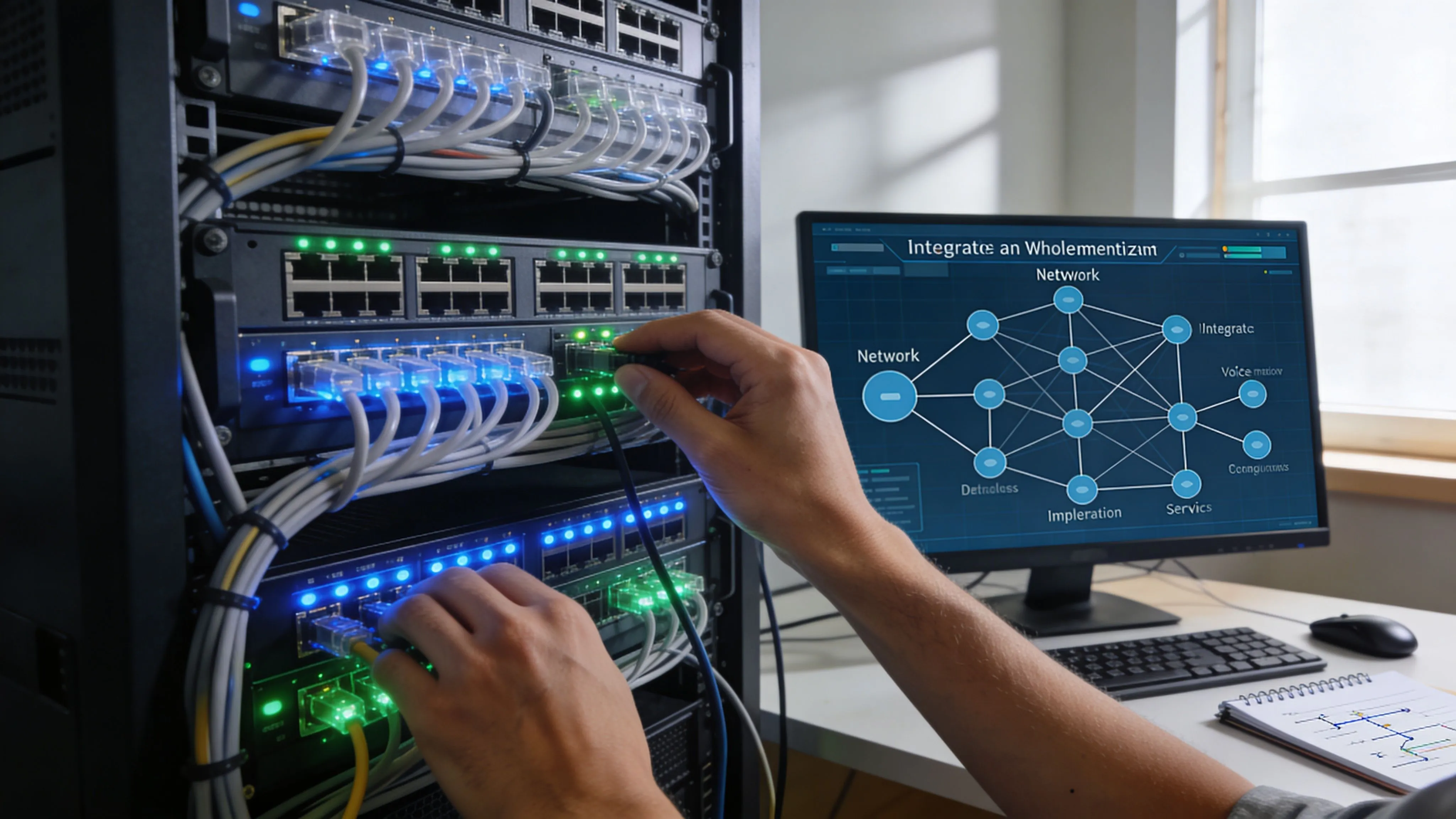
Implementation is where the abstract becomes real. This is the point where a business asks, "How do I connect this to what we already use?" For modern teams, the answer usually involves either APIs, webhooks, or a SIP connection into an existing phone system.

Two common integration paths
A startup building a calling workflow often doesn't need the same setup as a call center migrating a PBX.
API-driven integration
An API lets your application actively control voice functions. Your software can trigger outbound calls, create sessions, fetch usage data, or connect calling into product workflows.
This is the better path when developers want the product itself to "own" the voice experience. AI voice agents, browser dialers, and custom CRM call flows often fit here.
Webhook-driven integration
A webhook is event-based. Instead of your app constantly polling for changes, the voice provider sends your system a notification when something happens, such as a call being answered or ending.
Webhooks are useful for automations. They help update CRMs, trigger recordings, log events, or move the next workflow step forward.
APIs are for control. Webhooks are for reaction.
Migrating from a traditional phone setup
Businesses moving from older systems usually make the transition in stages rather than all at once.
A typical migration looks like this:
- Audit current call flows and note where calls enter, leave, and fail today.
- Choose the integration method that matches the existing stack. SIP for PBX-heavy environments, APIs for app-centric products.
- Test destination coverage and quality before moving production traffic.
- Roll out by team or use case instead of switching every department on day one.
- Monitor call logs and user feedback closely during the first live period.
The practical challenge usually isn't "Can this provider place calls?" Most can. The primary challenge is fitting voice into your systems without creating operational friction.
A short walkthrough can help visualize what implementation often involves:
What smaller teams often overlook
SMBs and developers usually focus on the call itself and forget the surrounding workflow. Before you launch, check these details:
- Authentication model: Make sure developers understand how the app will securely access voice functions.
- Call event handling: Decide what should happen when a call fails, is rejected, or reaches voicemail.
- Testing discipline: Try real destinations, not just loopback demos.
- Operational ownership: Someone on the team should own logs, alerts, and issue escalation.
If you're integrating voice into a product, success depends as much on workflow design as on telecom quality.
A Buyer's Checklist for Choosing Your Provider
Choosing a wholesale voice provider gets easier when you stop looking for "the best" provider and start looking for the best fit for your use case. A reseller, a remote sales team, and an AI startup may all need voice infrastructure, but they won't judge the same tradeoffs the same way.
The practical checklist
Use this list when comparing options.
- Coverage fit: Does the provider support the countries and call types you need, not just a long marketing list?
- Pricing clarity: Can you see rates, billing logic, and any recurring charges before signing?
- Route trust: Ask how the provider handles route quality, caller ID integrity, and problematic low-cost paths.
- Integration path: Do you need SIP, browser support, APIs, webhooks, or all three?
- Support model: Who helps when calls fail at the edge case you didn't predict?
- Compliance readiness: If your traffic touches regulated regions, ask how the provider supports local calling requirements and identity-related rules.
- Scalability: Can you start small without being punished, then grow without replatforming?
- Contract pressure: Are you free to test realistically, or are you being pushed into commitments before technical validation?
Match the provider to the operator
Different buyers should prioritize different questions.
Questions that expose weak vendors
Some providers sound strong until you ask for specifics. These questions tend to surface the truth quickly:
- Can we test with real destinations before any long commitment?
- How do you explain failed calls in a way a non-carrier can act on?
- What does onboarding look like for a small team?
- Where do we see usage, call events, and billing details?
- What kind of customer is your platform designed for?
If every answer assumes you're a telecom carrier, the product probably wasn't designed for your team.
A good provider doesn't just supply minutes. It reduces uncertainty.
The BubblyPhone Advantage for Modern Voice Needs
Many wholesale voice platforms still talk as if every buyer is a carrier, a large reseller, or a call center with a telecom operations team. That leaves a real gap for smaller builders and practical business users.


Where the market still falls short
As highlighted by Skyetel's wholesale page context, small developers and AI startups are often underserved by providers that focus on high-volume carriers, even though these builders need pay-as-you-go API access and WebRTC streaming that modern OTT-like models can provide.
That gap shows up in familiar ways:
- Sales conversations assume bulk commitments.
- Documentation assumes telecom background.
- Browser-based usage feels secondary.
- Smaller traffic volumes get treated like an afterthought.
For a developer building an AI caller, that model is frustrating. For an SMB that just wants straightforward international calling with modern integration options, it's equally frustrating.
Why an API-first model changes the experience
A more modern approach starts with a different assumption. Not every customer wants to become a voice wholesaler. Some just want programmable access to calling without telecom baggage.
That means the better model often includes:
- Pay-as-you-go access instead of heavy contract gating
- WebRTC support for browser-based calling
- Simple developer APIs for products and automations
- Clear per-minute billing that smaller teams can understand
- Fast onboarding without deep carrier knowledge
This is the core reason platforms such as BubblyPhone stand out for newer use cases. They align the infrastructure with how startups, distributed teams, and software builders work.
Who benefits most
This approach fits several groups that legacy wholesale content rarely speaks to directly:
- Developers building voice features into apps, assistants, or agent workflows
- Small businesses that need international outbound calling without telecom contracts
- Remote teams that want browser-based calling instead of complicated installs
- Freelancers and consultants who need flexible usage, not enterprise procurement
The key shift is philosophical as much as technical. Traditional wholesale voice asks smaller users to adapt to carrier processes. A modern provider adapts telecom access to the way smaller users already build and buy.
If you want a simpler path into international calling or programmable voice, BubblyPhone is built for that modern use case. You can start without contracts, use browser-based WebRTC calling, access transparent pay-as-you-go pricing, and build with developer-friendly tools that don't assume you're running a telecom carrier.