What Is an 877 Number? (2026)
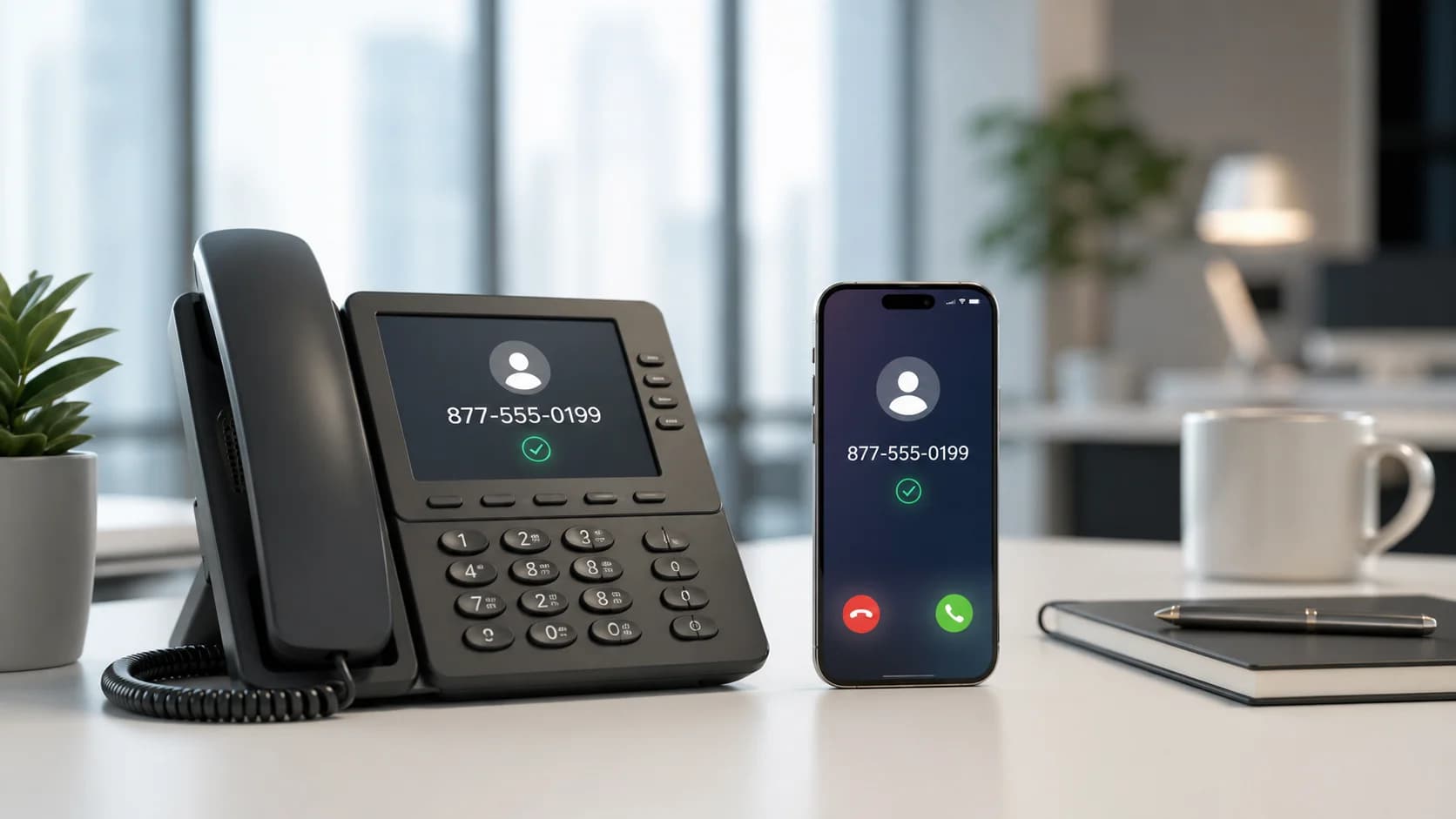
Table of Contents
- Quick definition
- Simple example
- Example 1: a legitimate 877 number
- Example 2: a suspicious 877 number
- What 877 does and does not mean
- What it does mean
- What it does not mean
- Where people encounter 877 numbers
- Why it matters
- 1. They assume 877 means a location
- 2. They assume 877 means the call is safe
- 3. They assume 877 is always free for everyone
- Common problems and misconceptions
- "Is 877 an area code?"
- "If 800 is taken, 877 must be the same business"
- "If the caller ID shows 877, it must be a real company"
- "Can I hide my caller ID when calling an 877 number?"
- "Can I text an 877 number?"
- "Can I call an 877 number from outside the US?"
- How to check or use an 877 number safely
- If you received a call from an 877 number
- If you need to call an 877 number
- If your business wants an 877 number
- Practical 877 scenarios
- When an 877 number is probably normal
- When an 877 number deserves caution
- Related guides
- FAQ
- Is 877 a real number prefix?
- Is 877 the same as 800?
- Is an 877 call automatically legitimate?
- Are 877 numbers free to call?
- Can 877 numbers receive texts?
- Does *67 work on 877 numbers?
- Is there an 877 area code location?
- Final take
Quick definition
An 877 number is a toll-free number, not a geographic area code.
It belongs to the same toll-free family as:
- 800
- 888
- 866
- 855
- 844
- 833
According to Somos, the current active toll-free codes are 800, 888, 877, 866, 855, 844, and 833, while 822 is reserved for future growth.
The short version is simple:
877tells you the number is in the North American toll-free system- it does not tell you where the caller is located
- it does not prove the call is legitimate
That is the mistake most people make when they see an 877 call on their screen.
Simple example
Here are the two most common real-world scenarios.
Example 1: a legitimate 877 number
You call an airline, bank, or customer support team on 1-877-....
That number is toll-free because the business pays for the inbound call inside the North American system.
Example 2: a suspicious 877 number
You get a missed call from 1-877-..., call back, and the caller says you owe money immediately or need to confirm personal details.
That does not mean the number is safe just because it starts with 877. The FTC warns that scammers can fake caller ID information, including numbers that look familiar or trustworthy.
That is the practical way to think about 877: it is a billing and routing category, not a trust signal.
What 877 does and does not mean
What it does mean
- the number is part of the North American toll-free system
- the receiving business or organization usually pays for inbound call charges
- it is intended to make it easier for customers to contact a company or service
What it does not mean
- it is not a city or state-based area code
- it is not tied to one location or time zone
- it does not guarantee the caller is legitimate
- it does not mean the matching 800 version belongs to the same company
Somos is very clear on one point that many articles blur together: 800, 888, 877, 866, 855, 844, and 833 are all toll-free, but they are not interchangeable and may belong to different subscribers.
Where people encounter 877 numbers
Most people run into 877 numbers in one of these situations:
- customer support lines
- sales and booking lines
- insurance, finance, travel, and utility companies
- government or nonprofit hotlines
- missed calls that look official but may or may not be real
- vanity numbers used in advertising
If you are trying to understand the broader US numbering system around +1, toll-free prefixes, and special numbers, our US country code guide is the best internal reference.
Why it matters
This matters because people routinely misread 877 numbers in three ways.
1. They assume 877 means a location
It does not.
Unlike a geographic area code, an 877 number does not tell you the caller is from California, Texas, New York, or anywhere else.
2. They assume 877 means the call is safe
It does not.
The FTC's caller ID spoofing guidance says scammers can fake the name and number shown on your caller ID. That means an 877 number can be perfectly legitimate, or it can be used as cover for a scam.
3. They assume 877 is always free for everyone
It is usually toll-free inside the North American system, but that does not mean it behaves the same way from abroad.
As our US country code guide explains, US toll-free numbers are not truly toll-free for international callers in the same way they are for domestic callers.
Common problems and misconceptions
"Is 877 an area code?"
People say "877 area code" all the time, but that is not really the right concept.
877 is a toll-free prefix, not a geographic area code.
"If 800 is taken, 877 must be the same business"
Not necessarily.
800-XXX-XXXX and 877-XXX-XXXX can belong to entirely different organizations.
"If the caller ID shows 877, it must be a real company"
No.
The FTC says caller ID can be spoofed, so you should never treat the prefix alone as proof.
"Can I hide my caller ID when calling an 877 number?"
Usually no.
As our anonymous calls guide explains, toll-free subscribers generally still receive caller information even if you try *67.
"Can I text an 877 number?"
Sometimes.
Somos describes toll-free numbers as being available for voice, text, or both, which means some 877 numbers support messaging if the business has enabled toll-free texting, but many still do not.
"Can I call an 877 number from outside the US?"
Sometimes, but not with the same assumptions.
The call may connect, may fail, or may not be free. If you are abroad and a company only lists an 877 number, look for a regular local number as a fallback.
How to check or use an 877 number safely
If you received a call from an 877 number
Use this checklist:
- do not trust the caller ID by itself
- do not share account details, passwords, or payment information on the spot
- do not pay by gift card, crypto, wire transfer, or payment app because the caller pressures you
- look up the company on its official website and call back using a number you found yourself
- if the caller claims to be government, law enforcement, or your bank, verify independently before doing anything
That last step matters because the FTC repeatedly warns that scammers pressure people to act immediately.
If you need to call an 877 number
From the US or Canada, you normally dial it as 1-877-XXX-XXXX.
From outside North America, use +1-877-XXX-XXXX if your carrier allows it, but do not assume the call will be free or even accepted.
If your business wants an 877 number
The practical reason businesses choose 877 is not that it works differently from 800. It is that the availability pool is different, which can make it easier to find a clean or memorable number.
If you are comparing a toll-free line with other business-phone options, our virtual phone number guide is a useful next read.
Practical 877 scenarios
When an 877 number is probably normal
- a return call from a company you already contacted
- a customer service line listed on the company's own website
- a toll-free booking, support, or claims line
- a number printed on official statements, receipts, or account materials
When an 877 number deserves caution
- the caller demands urgent payment
- the caller asks for one-time codes, passwords, or full card details
- the caller threatens arrest, account closure, or legal action if you do not act immediately
- the caller says not to hang up or not to call the company directly
- the caller says you must pay through gift cards, crypto, or bank transfer
That pattern is more important than the prefix.
Related guides
- US Country Code (+1)
- How to Make Anonymous Calls: *67 and Hide Caller ID
- Virtual Phone Number Guide
- How to Call the US from the Philippines
FAQ
Is 877 a real number prefix?
Yes. 877 is one of the active North American toll-free prefixes.
Is 877 the same as 800?
It is the same type of number, but not the same actual number. An 800 version and an 877 version are usually different numbers owned by different subscribers.
Is an 877 call automatically legitimate?
No. The FTC warns that caller ID can be spoofed, so a scammer can make a call appear to come from a trusted or familiar number.
Are 877 numbers free to call?
Usually for domestic callers inside the North American toll-free system. That does not automatically mean they are free from abroad.
Can 877 numbers receive texts?
Some can, if toll-free messaging has been enabled. Many cannot.
Does *67 work on 877 numbers?
Not reliably. Toll-free systems are one of the main cases where caller ID blocking is often bypassed.
Is there an 877 area code location?
No. 877 is not tied to a place, so there is no 877 city, state, or time zone.
Final take
An 877 number is a toll-free number, not a location.
That is the core answer.
The more useful answer is this:
- 877 tells you the number is in the toll-free family
- it does not tell you where the caller is
- it does not prove the call is safe
- it does not mean the 800 version belongs to the same company
If you see an 877 number, treat it like a phone-system clue, not a trust badge. Verify the business independently, ignore caller-ID assumptions, and focus on the caller's behavior rather than the prefix alone.